Showing posts with label Communism. Show all posts

Ping Pong as a Survival Skill -a Story from the Chinese Cultural Revolution

When we think of survival skills, many don't think outside the box or limit the range of such skills. Recently, I spoke with a Chinese friend who is from Wuhan, epicenter of the coronavirus. While he teaches at a college far from Wuhan, his parents still live there. As the entire city has been quarantined with no one going in or out, there is good cause to worry.

He said they are doing well but running low on food. He said he has been ordering food off the internet to deliver to them but it takes a long time to get there and he is worried. I asked if there was anything I could do. Of course, there's not really, and reminded him that his parents had survived worse and that his mother had once survived based on her ping pong playing skills.

Apparently, during the Cultural Revolution, a period of total chaos and dysfunction in Chinese history due to insane political extremism, at some point she'd found herself homeless and adrift in territories far from home. (I'm not sure how this happened, but it was not uncommon at this time. The authorities would occasionally order urban people, particularly intellectuals, to move to the countryside to "learn from the peasants" and since the peasants (farmers) often didn't particularly want them there, and society was falling apart, people would find themselves far from home without resources or food or means of making a living. It didn't help that young people were joining the Red Guards, roaming around unsupervised and trying to force the implementation of poorly thought out government mandates. They'd sometimes quite and try to find a way home too.

So this young woman, all by herself, far from home, found herself in need of food and shelter. Often one step in doing this was to find the local ping pong table where she happened to be and use it to make friends with strangers. Which often led to offers of a meal and food for the night.

(As an aside, due to China's high population density, people tend to often live in small, crowded houses or apartments. In a city like Wuhan, this would have made it difficult to stockpile a long term food supply, although a lot of the Karen (Burmese hilltribe) refugees I know in the USA have a few 50 pound bags of rice around somewhere in their houses or apartments. It's not a bad idea dn it makes them happy.)

Confucianism, Communism, and their Intersection in North Korean Symbolology.


Confucianism is one of, if not the most, influential of ideologies and philosophies that has shaped the thinking and culture of much of east Asia. (When I was at Cornell studying Chinese history and culture we used to refer to Confucianism as "the C-word" because whenever we used the term to discuss an aspect of Chinese history, a professor or class mate would be quick to seize on its use and demand that we clarified not just what we meant but which aspect or variation or interpretation of Confuciansm we were referring to.)

Confucianism with its strong emphasis on learning, education, and social training for the benefit of all has had great influence in this part of the world.

Some, mostly Koreans, would argue that nowhere has the influence of Confucianism on society and culture been greater than in Korea. (It's worth reminding people that for most of modern history until 1945, the Korean peninsula had been one unified nation and one unified people.) I remember once in Taiwan having a Korean state that Korean society was more Confucian than that of China and Taiwan. ( a statement many in China or Taiwan would disagree with, by the way, but interesting in that at least some Koreans claimed their society to be the best example of a Confucian society on the planet.)

But what about North Korea? Does its not just Communist, but extremely Communist, society show Confucian influence? Believe it or not the answer is a resounding yes and in many ways.

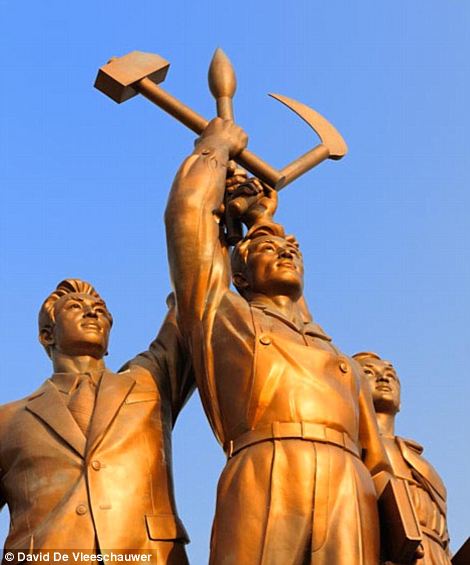
Remember this symbol, perhaps the best known Communist symbol in the world today?


This symbolizes the union of farmers and factory workers in Communist society. The scythe or sickle, symbol of the farmer, linked with the hammer, symbol of a factory worker, united together for the benefit of both. (at least that's the idea. Like many things, Communism was a great idea in theory but not so wonderful in practice, but that's a subject for another day. Just work with me here and enjoy the pretty symbols please.)

So, is this symbol used in North Korea? Well, kind of. Check this out.


This is the flag of the symbol of the Korean Workers' Party, the Communist party of North Korea. On the left, of course, we have the hammer, symbolizing the factory workers, and on the right, we have the scythe symbolizing the farmers, but what's this thing in the middle?

That is a brush, known in Chinese as a "mao-bi"( 毛筆 ) the traditional writing instrument of a Confucian scholar. After all, what would society be without the inclusion of scholars? 


This "hair pen" (some say the word "brush" is disrespectful in this context) is given a place of reverence and cared for carefully. It is a symbol of education, learning, good manners, and tradition and should be treated as such.


And in Korea, even after decades of Communist dictatorship, it is still treated as one of the symbols of a sound and healthy society, something that needs to be included if people are going to work for the greater good.


MORE READING

Korean Calligraphy


The Flag of the Korean Workers' Party

Trump and Musk -What is motivating them? What is their end goal? Partial thoughts First

Trump and Musk -What is motivating them? What is their end goal? Partial thoughts First . . . what the heck is going on here? What are Donal...