Showing posts with label European history. Show all posts

Book Review: Terra Cognita -The Mental Discovery of America, by Eviatar Zeruvabel


Years ago, I had the opportunity to ask Magnus Fiskesjo, one of my thesis advisors at Cornell, about Gavin Menzies books on his alleged (and easily disproven) claims of the Chinese discovering America. Dr. Fiskesjo recommended I read this book instead, I did and found it quite interesting and encourage others to do so as well. Please note while I read the first edition, there is now a second edition of the book. (This essay was originally written as a review on . Amazon.com)


Terra Cognita: The Mental Discovery of America by [Zerubavel, Eviatar]


As we all know, Columbus was not aware in 1492 that he had landed on a new continent. Hence the lingering odd term "Indian." This work discusses in great detail the often ignored process, and it emphasizes process, of how and why and when Europeans began to realize that they had discovered an entire new continent (or two) that was completely unconnected with Asia.

The author is an Israeli geographer and does this in large part through discussions of period maps and a couple globes. (The work includes 31 plates of period maps showing how cartographers in Europe viewed the relationship between newly discovered areas of America and the rest of the world.) He emphasizes in great detail the need to look at varying definitions of terms like "continent," "discover," "North America," and so on.

A great deal of time is spent not only on explorers, be they Spanish, Italian, Viking, English or Russian (who approached North America from the West but were the first to truly prove it is not attached to Asia) over a period of many centuries, as well as the cartographers and writers in Europe who disseminated, analyzed, sorted, filtered and processed the new information that was being uncovered and tried to put it in a context. (In fact, this work was first recommended to me by a professor who recommended it as partial refutation of Gavin Menzies silly claims that the Chinese not only discovered America in 1421, but, somehow, instantly new what it was and then told Columbus.)

Best of all, the work is only 118 pages long, plus plates and footnotes, making it a relatively quick read.

It does provide a great deal of information on the context of actions that might otherwise have been missed. (i.e. Coronado was apparently searching for a mythical seven cities of gold, but was not sure how these cities related to the civilization of China and the spice areas of SE Asia, for instance, and thought there might be a connection between the two.)

Updates on the Roman Arena Model --Building Stands for Spectators

This blog has been a bit too quiet lately, perhaps making people wonder where I am. Much of the history / blogging/ wargaming / miniature modelling time has been devoted to this, working on adding to my representation of a Roman arena for miniature wargaming of Roman gladiatorial battles.

As some can see, the actual arena was constructed some time ago and I decided to add stands to it and hope to do so before the local wargaming convention, the Council of the Five Nations, where I am scheduled to run a game using the Hoc Habet Hoc rules. 

Here's a few photos of the project under construction. 


While the model is quite large, 40" (101.6cm) in diameter, with three levels of stands, compared to the actual, historical arenas, it would be quite small. Therefore, it's safe to say it's a representational model, designed to give the feel and general look of a Roman Arena, quite suitable for gaming, but not an actual reproduction of one, and probably would not be suitable for a museum exhibit. 

As you can see in the above picture, the arena itself was already built (a project I should describe in a future post perhaps) and the "only" thing needed was to "just" add stands. I began cutting foam card and soon had two large half circles with a 20" (a little over 50cm) radius. 

Then I added three levels of stands, each curved on the outerside of the large circle, but being 8" ( a little over 20cm), 5"  ( a little under 13cm), and 2 1/2" (a little over 6 cm) deep. 


Next came adding wooden spacers to separate the levels of the stand. These were quickly cut from long square pieces of wood and made slightly shorter than the depth of each layer of the stand. 

The pieces were then attached to the wooden spacers with a heavy duty stapler and lots of carpenter glue. 


Here's a photo of the project as it currently looks.


A photo of the arena itself from a gaming session.

Historical European Martial Arts (H.E.M.A.), the Rondel or medieval dagger, and the Fiore Dei Libri manuscript


The study of history need not be a static, sedentary thing. For one thing, there's a lot there, like everything that ever existed, and much of it involved doing things.

Which brings us to the modern activity of "Historical European Martial Arts" (Also Known As "H.E.M.A."), a 600 year old book called "Fiore Dei Liberi's Armizare", and a medieval dagger known today (but not in medieval times) as "the Rondel." 
Late Medieval European daggers 
Going in reverse order, the Rondel is the modern name for a medieval dagger that resembled a large ice-pick more than it did a modern fighting blade. While most modern fighting knives are designed for slicing and cutting, techniques that can be deadly in most hand to hand combat situations, the rondel was adapted for fighting opponents in plate mail. A modern sharp bladed dagger would not do much damage against an enemy encased in medieval plate armor. Attempts to cut the plate would most likely do little damage to the person inside, while dulling the blade. By contrast, the long, narrow, sharply pointed rondel, if stabbed forcefully had a better chance of both piercing the plate than a wider knife, it also could slide through the cracks and joints in the armor, thus reaching the person inside. The rondel was a common weapon in the days when Europeans fought in heavy armor.


An excellent book on the use of the medieval
dagger as taught in the Fiore Dei Liberi
manuscript aimed at a modern audience.


But how exactly did people fight, or train to fight, with the rondel? How did they move? How did they hold their hands and move their fight when they did? Were their techniques and movements, or series of movements and techniques, which they practiced during training?

Although much of the details are conjecture, speculation, and, at best, educated guesses, we do have some information on these matters due to the existence of a 600 year old book known as Fiore Dei Liberi's Armizare. This was a hand drawn, Italian book dating from 1410 on fighting from the time, and it is often considered the oldest known comprehensive manual on hand to hand armed and unarmed combat in the European tradition. Four copies of the book, each slightly different, have survived and are located in museums around the USA and Europe.


Although the Fiore Dei Liberi manuscript describes
a good quality plastic reproduction of a
medieval dagger from the Cold Steel
company built for safer training
 techniques for unarmed combat, swordsmanship (using the hand and a half sword of the time), axe, spear, as well as other weapons, a large portion of the work covers techniques for attacking with the rondel. For each of these techniques there is then a counter, called "a remedy" in the terminology adapted for the book, and then each of these counters has its own counter, charmingly called "the remedy master."

The work and its illustrations give clear descrptions of what each technique is supposed to look like at various points in the process.  However, there is some debate over what happened or should have happened at the points in between the illustrations. Furthermore, as the art and techniques described in the book died out at some point centuries ago, unlike some Asian martial arts, there does not exist a lineage of living masters of the art who passed the teachings down from one student to another.

The author on the left preparing to defend
himself from a simulated medieval dagger
attack at a training session in the Boston area.
Nevertheless, some people today, in organized groups or as individuals, do attempt to recreate and practice the techniques in this work. For obvious reasons, what they are doing is an interpretation and may or may not be what the author of the book intended when he wrote and taught in the fifteenth century. But in most cases, students of the art have put much time and effort into learning what they can about body mechanics as well as fighting techniques, in order to try and achieve recreated techniques that are reasonably sound in practice and thus more likely to be close to what the original practitioners of this art did.

Such groups fall under the umbrella term of "Historical European Martial Arts" or H.E.M.A. I've participated in a small way with two different H.E.M.A. groups and enjoyed the experience. They were fun people and their gatherings were both fun and good exercise.

More on the Rondel and how it was used as taught in the Fiore Dei Liberi's Armizare is below.


An Excellent Series of Training Videos from the North West USA


Further Reading

Roman Gladiator Miniature Wargaming figures


Notes: 
1. If you would like to see your products reviewed on this blog please contact us.
2. Please support this blog and its author. BUY MY BOOKS!


Chief among my writing projects is a Wargamers guide to Roman Gladiator gaming. Therefore expect posts on the subject.

For our first, a quick view some of the figures involved. These figures are generally 28mm tall and were manufactured by either Brigade Games or Crusader miniatures, two of the best manufacturers of historically authentic Roman Gladiator gaming miniatures. 

All figures were painted by me. 

Gladiatorial battles in the arenas of the Roman Empire are an interesting and complex topic. 

Gladiators tended to fit certain "types" and although some variation and creativity was allowed, these types were mandated by law. Furthermore, the crowd and the sponsors knew what they wanted and despite some local and regional variation gladiators tended to fall in certain categories.  

Hoplomachii -a stylized Roman idea of what a Greek warrior should look like. The figure on the left is from Brigade
Games while the two on the right are from Crusader. 


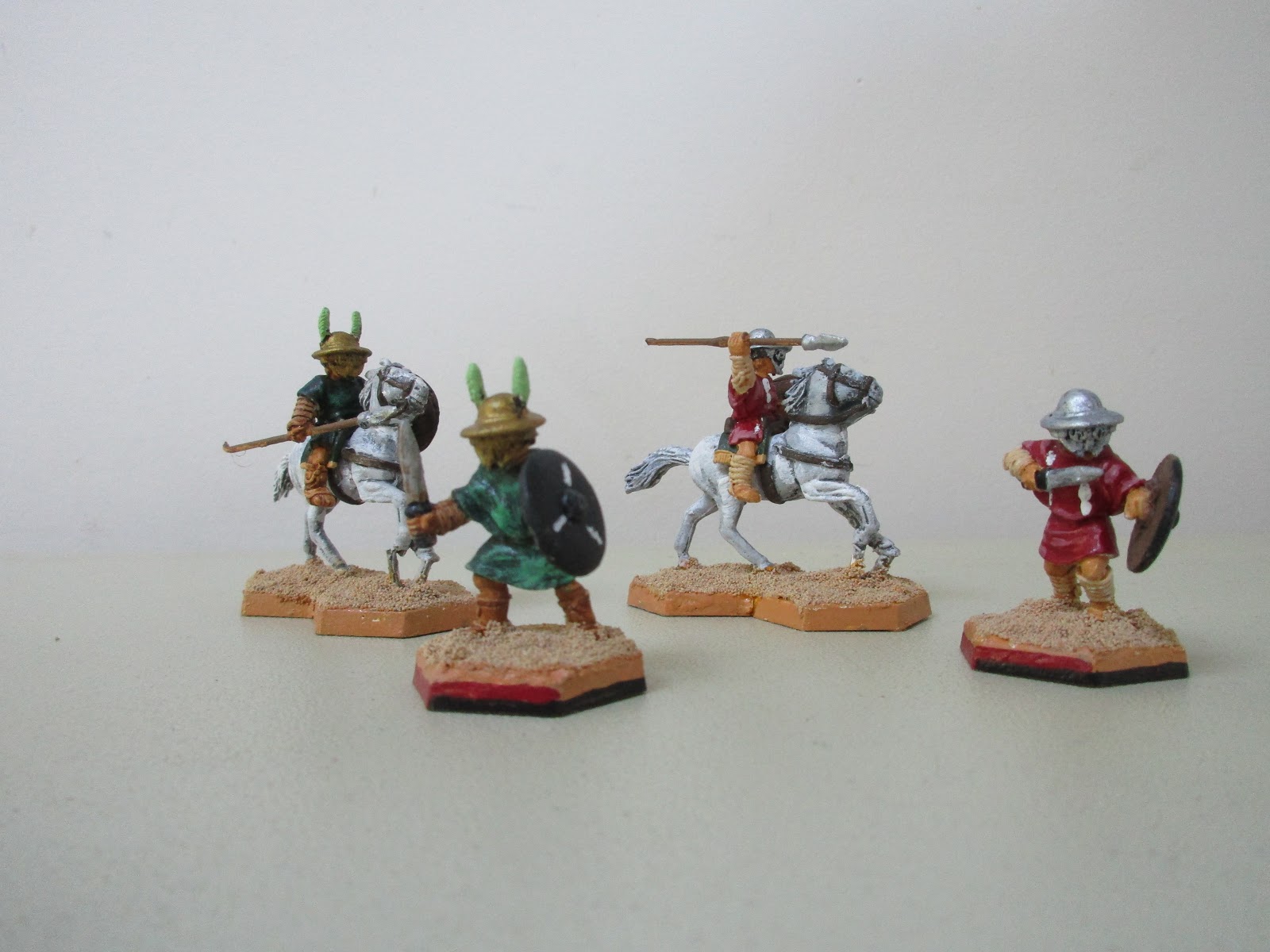
Eques -Gladiators who began their combat on horseback but then dismounted and fought on foot. They were only paired against each other. Figures are from Crusader Miniatures.


Unusual gladiators -on the left we have a pair of Arbelas or Scissors and on the right we have a pair of very heavily armored Crupellarius. In both pairs the figure on the left is from Crusader Miniatures while the one on the right is from Brigade Games.


Thracians -a heavily armored gladiator that was based on the Roman stereotype of a Thracian warrior. The Thracians lived in what is now Bulgaria. Figures are a mix of Crusader and Brigade figures.


Secutores -a heavily armored gladiator who specialized in fighting the retarius,. Again, figures are a mix of Brigade and Crusader Figures.


Dimachaeri -Figures who fought with two swords and no shield. The two on the left are from Crusader and the one on the right is from Wargames Foundry. I am not sure if he is authentic as his face is exposed. Few gladiators fought this way.
Myrmillio -a common type of heavily armored gladiator. A mixture of Crusader and Brigade figures.

Two packs of condemned men from Crusader Miniatures facing a lion from Monday Knight Productions. Not exactly gladiators but part of the millieu.  Romans believed in public punishment and execution.


Spectators, officials, casualties and wounded and defeated gladiators from a variety of manufacturers.


Retarii and Laquearri -these figures came from a variety of sources including some Brigade figures (no Crusader) as well as some bargain bin figures whose origins are completely unknown. A couple came from RAFM who produced a pack of gladiators in 25mm some of whom I question as to their historical accuracy.


Old Minfigs 25mm Gladiators from the 1980s.


Trump and Musk -What is motivating them? What is their end goal? Partial thoughts First

Trump and Musk -What is motivating them? What is their end goal? Partial thoughts First . . . what the heck is going on here? What are Donal...