Cannons at Fort Ticonderoga


(I am going to post this but not advertise it until it is polished a bit more. If you run across it in the meantime, congratulations!! If you wish to see me polish it more quickly, say something nice or add a citation in the comments section. Thanks.)

Greetings. I've got lots of good stuff stored away, all ready to share, but find myself held back by the "But it's not good enough yet." Truth is, I've never really understand the issue with "writer's block," the inability to find a subject to write about or finding yourself unable to actually choose or find the words to put on paper. I have, however, often found myself fearful of putting things out in public knowing that they were not as good as they could be, fearful that people will judge me or my work by something that was dashed off in a hurry without huge amounts of thought or polish. ALAS!! 'Tis the nature of blogging, so . . . here goes. --A far less than perfect mini-essay on the artillery at Fort Ticonderoga, a historical site on the shores of Lake Champlain in upstate New York. 

Fort Ticonderoga, originally named Fort Carillon, featured prominently in the French and Indian War (the North American campaign of the Seven Years War in Europe) and the American Revolution (War of Independence if you are British, although I am quite comfortable calling it a revolution as it brought huge changes to not just the inhabitants of the former 13 colonies but also the world). The fort was located to provide its owner with control over the southern portion of Lake Champlain, at that time a major shipping and travel route between Canada and the USA. Although it was never easy, one way to get men and materials from Montreal and the City of Quebec was to go down the St. Lawrence, cross overland until one reached Lake Champlain, boat down the long lake, cross overland to the smaller but still important Lake George, boat down the lake, then cross overland to the Hudson and then one could boat all the way through to Albany and then to New York City. 

In the earlier French and Indian War, it was the site of two different battles and changed hands from French to British control once. During that war, the presence of large quantities of artillery inside the fort led to the defeat of the first attack on the fort. During the American Revolution, however, the goal for those who controlled the fort was not so much to control the fort itself but instead to gain control of the cannons inside. 

In 1775, fighting  broke out in Boston. The British army that was located in the city, found itself besieged and surrounding by large numbers of American militia, rebels who were loyal to the Continental Congress and the rebel cause. These rebels felt more cannons and artillery would help them defeat the British, and soon someone (perhaps Henry Knox, head of the artillery section of the American army at the time)* suggested that troops be dispatched to Fort Ticonderoga to take the fort and gain control of the cannons. 

Ethan Allen of the Green Mountain Boys and Colonel Benedict Arnold* were both sent to work together and take the fort. Although squabbling over who was in command (memory tells me that the Continental Congress had given Arnold letters stating he was to take command, letters that were completely ignored by Allen and his men)*. Regardless, the force arrived at the very isolated fortress, entered the fort through the main door which was unlocked and guarded by a single sentry, and took it without a shot. It seems that up in the Adirondack Mountains, word had not yet reached the men at the fort that an active rebellion was underway so, believing they were at peace, they had no reason to be wary or suspect that an attack might take place. 

According to legend, the commander of the fort was woken in his pajamas and when told by Benedict Arnold that his fort had now been captured, asked "In whose name do you take the fort?" 

Arnold is reported to have replied, "Sir, I take your fort in the name of the Great Jehovah and the Continental Congress."   

And thus the fort changed hands and 59 of the cannons inside were hauled off using oxens and sledges and taken to Boston to aid in the siege. 

The Americans then held the fort until Burgoyne's southward moving force passed through the region on its way to the fateful Battle of Saratoga in 1777, but was, according to the guides at the fort today,* abandoned by the British until about 1780 or 1781 when a small British force came down from Canada to try and rally loyalist support and recruit American help for the crown* (a continuing yet never terribly successful thing that the British tried to do periodically throughout the war.) When news or Yorktown and the British defeat reached them, however, they soon realized the war was over, they'd lost, and headed back home. 

Today, Fort Ticonderoga is a privately held historic site, and is well worth a trip if one is interested in the history. It houses one of the largest collections of 18th C artillery in North America.

* Indicates a fact that I would like to look up, verify, and expand upon. However, it is this very need to do this that has kept you, my reader, from viewing my photos of Fort Stanwix, Saratoga Battlefield, and more sites. If you wish, please feel free to comment and / or add sources and citations in the comments section.


A collection of cannon balls and artillery ammunition from the fort's wonderful museum. 

A diorama from the museum of the artillery being hauled to Boston


An Introduction to the Quantity of Cannons at the Fort

Pretty self explanatory. As the fort shifted hands multiple times, and each time not only were the cannons taken out and moved elsewhere but usually an attempt was made by the defeated party to destroy as much as possible before handing the fort over, the number of the cannons inside the fort varied widely during many years and two wars. These charts illustrate the number at any given year.


Mortars at Fort Ticonderoga


A small mortar at the fort

Another view of the same mortar

A third view of the same mortar


An Artillery firing Demonstration

Every day the fort has a demonstration of artillery firing. Or, at least, my impression is that it is once  a day. A crew of four, dressed in French uniforms of the style from the days of Fort Carillon fired off what they indicated was a four pounder field artillery piece.  I took a lot of pictures hoping to catch the firing at just the right time and I share them all here.


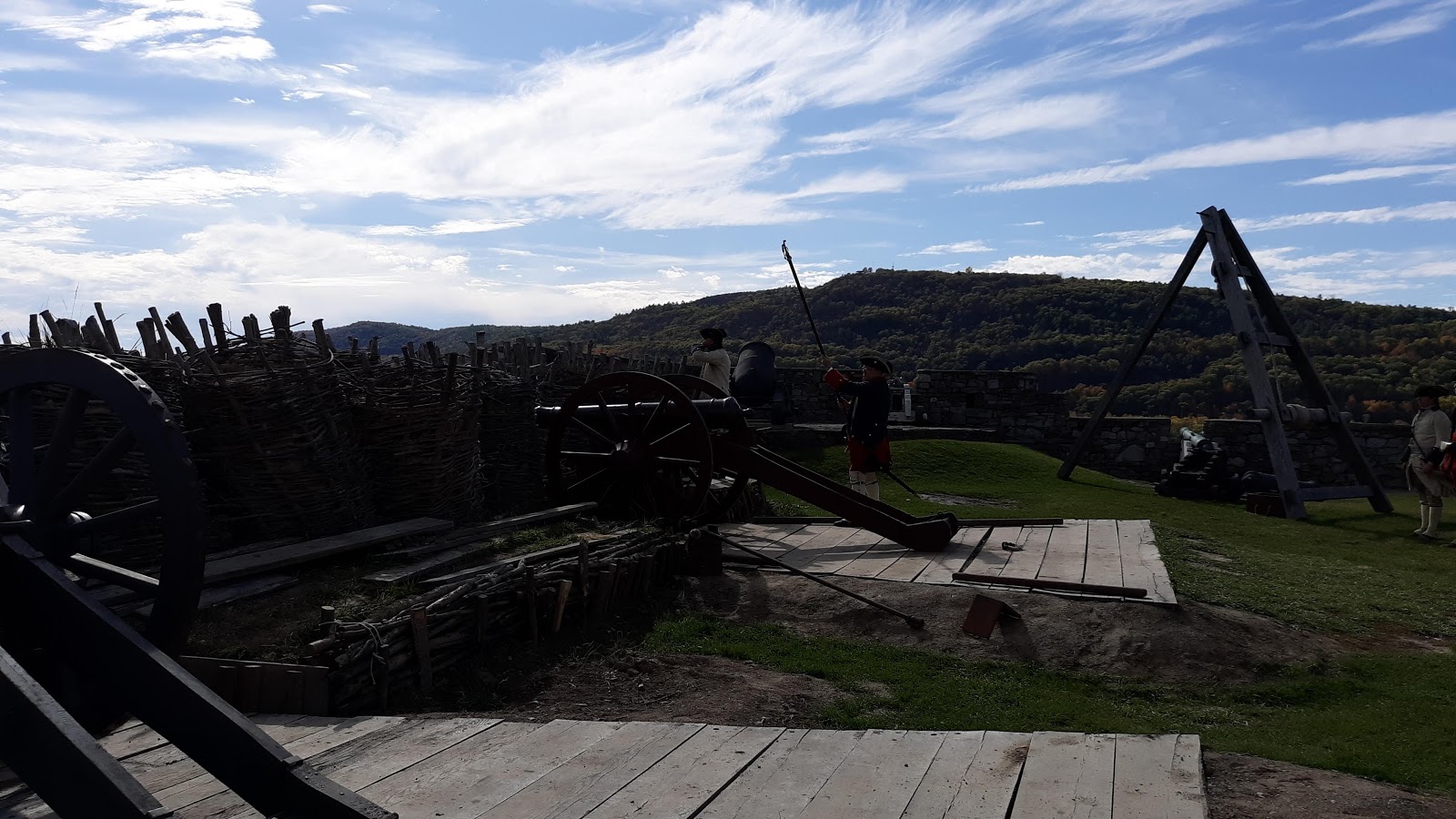


Gabions


Field Artillery in the Museum


Random Shots of the Fort 

Just a variety of shots of random things taken at the fort when I visited today. A more skilled or selective blogger would probably edit them, leaving only the best, but I figure perhaps there is something here that will excite someone and how am I able to determine what that is? Enjoy please. Leave a question in the comment section, if you have one? Thanks.


FINALLY
books by me. If you really want to support this blog,or enjoy it and wish to see what else I've done, please check this out. Thanks.


Trump Watch: Trump and Social Media Culture, Responding to Trump in a Fractured World

As some of you may know, I have more than once blog. In my other blog, I am starting a series where I use the tools and skills I have learned through studying history to try and understand Donald Trump. Love or hate him, he's definitely a person historians will be talking about for a long, long time.


https://peterhuston.blogspot.com/2019/07/trump-watch-trump-and-social-media.html

The American Revolution --"WE should rule OURSELVES" and European thought.

Random thoughts from the last few days:

No one should be mocked for the color of their skin or their sex and that includes White males. Nuff said. Not sure why it has become fashionable in some circles to pretend this isn't racism, but it is. The goal, I thought, was to work towards an America that was a color-blind meritocracy where people of all classes and colors work in harmony and if you think this sort of divisive nonsense somehow helps, well, you are wrong and deserve to be called out on it. Nuff said.

If you think it is appropriate to mock White Males because they are White Males then your vision of America and its ideals does not match mine because my vision of America welcomes people of all races, and colors and I will resist you. Simple enough.

Second, three days after July 4th I find myself reading a classic historical work on the Hessians and other German Auxiliaries of the American revolution. (I finished the book on the French in that war.) For those who don't know their history, in 1775, the British government found itself faced with a large scale uprising in its North American colonies. They needed to send large amounts of troops to try to put down the armed uprising. There were not enough British troops to do this and meet the other obligations of the British army. So the British government looked to hire troops abroad to send to fight in America. Germany was not a unified nation and instead a collection of independent feudal states of various sizes. About half a dozen of the petty tyrants of the minor German states agreed to rent or sell their subjects and citizens to the British with the plan being to put them in military units and ship them to America to fight in a distant war all without their consent or agreement.

As Hesse-Hanau sent the most, such troops are often called Hessians, but this was not the only small German state that sent it's citizens to the USA.

Along the way, the German draftees at times tried to mutiny and riot or escape, but most got to America where they fought George Washington, the other patriot leaders, and their armies. (Please no airport jokes, please. They've worn thin.)  And they often fought surprisingly well once there, and despite not having chosen their lot, there seem to be few if any records that they considered their fate to be unjust, immoral, or a sign of an underlying social or political problem. After all these Germans considered such acts by petty tyrants to be a natural state of affairs for mankind. Instead they seemed to have just considered themselves rather unlucky to be the ones having gotten chosen to do this, but it was only natural to expect such things to happen and it wasn't something one could really do anything about.

Which sort of makes me think how amazing it was that the Americans of this time said "WE should rules OURSELVES." And that was a pretty radical idea for the time. A very radical idea.

And then they tried to make it happen.

And while half informed pseudo-intellectuals today are quite quick to say "What about the Indians? What about the Blacks? The women?" and then use this as a reason to dismiss the entire process and events of the American Revolution as somehow being unimportant and even immoral, they're missing the significance of the whole thing.

The idea was "WE should rules OURSELVES."

And this was in direct contrast to how the Germans of the  day lived.

The Germans sort of thought "WE are ruled by others, WE have no say in the process, and that is the way things always have been and always will be. It is natural.

And not only that, the bulk of the German citizenry had never considered that there might be a better different way to be governed.

The Americans of the time had begun to think outside the box, outside the traditional cultural framework of most Europeans of the time.

The idea that "WE should rule OURSELVES" was a radical one.

And what about the Indians, well. they were clearly not "WE" to the Americans of the time. The Indians were "THEM", the classic other, and, besides not only were the bulk of the Indians already ruling themselves, but they had no desire to become part of the American governmental system and its ethnocentric to think they would have. (Heck, there are still Iroquois today, Mohawks in particular, who are asserting their independence from the USA and its government. I'm not saying the Indians were treated fairly at this time, they weren't, but that does not mean they wished to become US citizens. The issue is, as they say, complicated.)

And the Black slaves, obviously a social and moral problem of the time that still has continuing repercussions today, cannot be ignored. The role of Blacks in the armies of the American Revolution (they fought in surprisingly large numbers on both sides) being a very complicated issue. It was essentially, a war for freedom being fought by a society that had legal slavery, an issue that was grappled with for years and finally only settled with a surprising amount of bloodshed.

But one that does not need distract us from the radical notion of the time that "WE should rules OURSELVES."

Clearly America still had a need to work out for itself who it meant when it say "WE" but the notion was still important and revolutionary for its day.

Women, the same thing. "Are they WE, US, or THEM?" Another issue worth looking at. Despite the presence of religious groups like the Quakers who practiced equality for women and the nearby Iroquois who had developed a Democracy that pre-dated the contact with Whites but one where, interestingly enough, only women could vote, it would be astonishingly long before women got the right to vote in the USA. (Women only got the right to vote in the USA in 1920,believe it or not.)

But regardless, the notion that "WE should rule OURSELVES" was a surprisingly radical idea for the time and an idea that was completely alien to much of the European population of the time.


You can find a PDF of Lowell's book here: https://themarshallhouse.org/assets/pdf_files/Lowell%20-%20Hessians.pdf

If you prefer, you can buy a copy. As the work is out of copyright, it is available from multiple publishers. If you buy though these links you will support this blog.


StarZ TV Spartacus series, were the fight scenes accurate? Part One - Arms and Armor.


I've recently begun rewatching the TV series Spartacus, a show that ran for four seasons on the Starz Cable TV network. (It's a rumored there may be a fifth one some day. We can only hope.) While one of the most lurid and visceral television spectacles, I've ever been exposed to, the show is exciting, entertaining, and addictive, just be careful who you watch it with. The high levels of  sexual content and nudity, as well as violence and blood splashing gore, is higher than in any television show I've ever seen.

As long time readers of this blog (or you intelligent people who actually take the time to look at old posts) know, over the last few years, I've done a lot of research into the Roman gladiators and done some wargaming and figure modelling for the period. (In fact, one of my motives for rewatching was trying to find ways to add backstory and better characterization to my historical miniature games based on Roman gladiators.)

For those wondering, Spartacus was an actual historical figure. There was indeed a gladiator who fought under that name, who led a gladiator uprising that became a major slave revolt and troubled the Romans for years until he and all his followers were put down. The series is a cinematic retelling of this historical event, and while much of the details remain unknown, and there are few first hand period sources to tell the story, the series creators freely admit they took great liberties with the actual history. For more details on the actual history, I've included links to a few well chosen books, all books that I've actually read, below and if you purchase them by following these links, you'll also help support this blog.

For now, we're focusing on the gladiatorial fight scenes in the arena and their historical accuracy, nothing else.


A key fight scene from Spartacus: Gods of the Arena. 
While the second season filmed, this six episode mini-series is actually a prequel to the events that occur in season one. The titular character Spartacus never appears, but we get to see more of the villainous ludus owners, a ludus being a gladiator school or troupe, who own and train and fight the gladiators, and learn more about what it was like to be part of this establishment and owned and forced to fight in the arena against one's will. 


I hope to write a few blog posts on the degree of accuracy of the fight scenes in this series, but for now:  

1. General accuracy of the arms and armor and fighting styles: 

Much to my pleasant surprise, this is actually quite high. If you watch this show, the portrayal of the gladiators and their equipment is quite accurate, particularly since many cinematic depictions of gladiators are completely off.

The gladiators fought in certain distinctive ways using distinctive styles of armor and weaponry. During the latter part of the gladiatorial period, while there were local variations and locally known styles of fighters, the types allowed in the arena was largely proscribed by law.

For instance, in the scene below we witness two fighters. One of them is wearing heavy armor and carrying a straight, short sword -the Roman gladius- and carrying a large shield similar to what a legionnaire of the time would wear. This type was called a "mymillio" and the characters in the series refer to the fighters garbed and equipped in this way by that name.

The other carries two swords and is clearly intended to portray a "dimarchus," a gladiator who fight with two swords or one sword and a dagger.

To my mind there's nothing grossly wrong with the depiction of the Myrmillio. in the scene above. If I quibble, pontificate, and wax pedantic, then I must point out, for instance, that while his helmet does look like the helmet of a myrmillio, the perfect helmet for a myrmillio would look exactly this BUT with the addition of a fish, yes, a sculpted fish, added to the crest of the helmet. (This made more sense, from the Roman perspective, when you remember that a Myrmillio was often matched against a Retarius, the net and trident man. Therefore, ipso facto, par for the corso, ergoto, you would have a fisherman --the net and trident fighter-- fighting an opponent with a fish on his helmet. See! It makes perfect sense. Fisherman VS Fish. Understand that, learn some Latin and you'll soon be right up there, seeing the world from the traditional Roman perspective.)

And in a perfect world, the Myrmillio would also wear one greave, a piece of armor for his shin. Interestingly enough, most Myrmillio only had one greave, and it was on the right shin on the side opposite the heavy shield. While Roman soldiers wore them in pairs, gladiators often did not, and many of the carefully defined classes of gladiators wore just one with it being carefully prescribed as to which side of the body they wore it. If you look carefully this gladiator, this Myrmillio, has no leg armor, but you have to watch real carefully and be looking for this detail to even notice.

As for the character, Gannicus, the man with the two swords in the above clip, he is fighting in the style of a dimarchi. This is also a historically recognized style of gladiator, but one not as common as the myrmillio.

Here, I have a bigger quibble, a more glaring complaint. Historically the fighter really should be wearing a face concealing helmet, something much closer to that worn by the myrmillio in the clip.

Face concealing helmets were an important part of the dress of most gladiators. Not only did they protect the face, but they also concealed it, dehumanizing the wearer to his or her opponent. Gladiators were often paired off to fight with other members of their own ludus (school or troupe). And they had no choice in the matter,

Not only did they tend to fight harder when they couldn't see the face of their opponent, often a friend or colleague, but the concealing helmets often concealed their fear and anxiety about the match. Therefore face concealing helmets were a pretty standard part of most gladiators gear.

Interestingly enough, the retarius, the net and trident fighter, was one of the few types that did not normally wear a face concealing helmet.


A gladiator game I held at the Council of the Five Nations, a local adventure and historical game convention. I've since expanded the arena and built stands. If you blow up the picture you can see a pair of retarii, fighting a pair of secutors while a Myrmillo and a referee watch.
By contrast the only known period depiction of a dimarchi, a sculptural bas relief, shows him wearing a face concealing helmet and holding two swords, one of which is curved,

Yet throughout the Spartacus series characters tend to fight without helmets, Why? If you watch the scene, it's obvious. Gannicus is a handsome, well built man with an expressive face and a roguish grin.  If you watch, you can clearly see that he's quite comfortable in his role as star gladiator, enjoying the fight, the adulation of the crowds, and even the thrill of the kill. And if his face were concealed? Well, you'd get none of this. Characterization and story telling benefits in this case from the removal of the helmet.

If you watch the series, other types of gladiators are reasonably well portrayed --aside, of course, from that matter with the face concealing helmets. The characters usually seem to have a helmet where you can see their face or at least enough to get a sense of their emotions, or else, perhaps even more foolishly, they somehow manage to lose or pull off their helmets in the heat of battle.

Still the gladiators portrayed in the Starz TV series Spartacus do tend to fall within recognized historical types and be reasonably well portrayed.

The retarius are there, although interesting some do have helmets. The thracians with the curved swords. The hoplomachii with their long spear and small shields and faux Greek style helmets. The secutors, a type of gladiator that was equipped similar to the myrmillio but had a smoother, rounder, helmet so that it would be less likely to be snared in the net, All these can be seen, and are depicted with reasonable yet less than 100% accuracy, in the show.

Recommended books on Types of Gladiator and their 
Arms, Armor, and Fighting Styles


These three books all have good details on the types of gladiators and how they fought. My personal favorite is Nossov's Gladiator, Rome's Bloody Spectacle and I can't recommend it highly enough if the subject interests you. The Gladiators and Caesars book is also quite good, but be forewarned only one chapter of this book focuses specifically on gladiators. The others tend to discuss things like chariot racing or animal fighting or other arena and coliseum type events.


This is an unusual yet well done book that contains interesting but largely hypothetical descriptions on how to train and fight in a realistic manner that may be similar to how the Roman gladiators fought. It's currently being sold by two different publishers so it's available on Amazon from two different sources. After Paladin went bankrupt, the rights reverted to the author and it was soon re-released.


Finally, a pair of books on the history of the Spartacus revolt. I've read both of these (I've read everything I've linked to on this page. In some cases, you can even find my reviews on Amazon for the products.) and I definitely prefer Strauss's The Spartacus War over the Osprey book. I have however included the link to the Osprey book as many people (myself included) just like Osprey books and they don't take up much space on the shelf. 


Finally, if you wish to support this blog, please consider buying any of the following books, all written by yours truly. People who've read them, tell me they've enjoyed them. 


Current Reading: Endurance, Shackleton's Incredible Voyage, by Alfred Lansing


Endurance, Shackleton's Incredible Voyage, by Alfred Lansing. 1959. Carrol and Graff Publishers. New York. 282pp. 

In 1914, a British expedition set sail for Antarctica. Carrying 27 men, its goal was to land on the southern continent and be the first men ever to traverse the continent on foot. Unfortunately, the expedition soon met with tragedy. The ship, The Endurance, became trapped in the ice and unable to escape. As the ice shifted and pressures on the ship grew, it became clear that the ship was going to be crushed and the only sane course of action was for the men to abandon the ship and set up camp on the Antarctic coast. Trapped, with no way home, but fortunately still equipped with a shipload of supplies, these men under the command of Ernest Shackleton survived six months alone and abandoned and out of communication with the outside world, moving camp and travelling several times in the process. And not a single one of them died despite these harsh conditions in one of the most dangerous places on Earth.

It's an amazing story and one that's been told many times in many formats including both books and documentaries. Yet this book is considered the classic. It often appears on lists of recommended non-fiction or top 50 non-fiction books you must read and so on, It's been on my personal list of desired reading for years, I think, and it's often recommended reading in schools or courses on leadership. Much can be learned of leadership and management from following the actions of Shackleton as he kept his men together, united, and focused despite challenges from weather, boredom, a sense of feeling trapped and hopeless and more, 

I'm about  a third of the way though this book but enjoying it greatly.


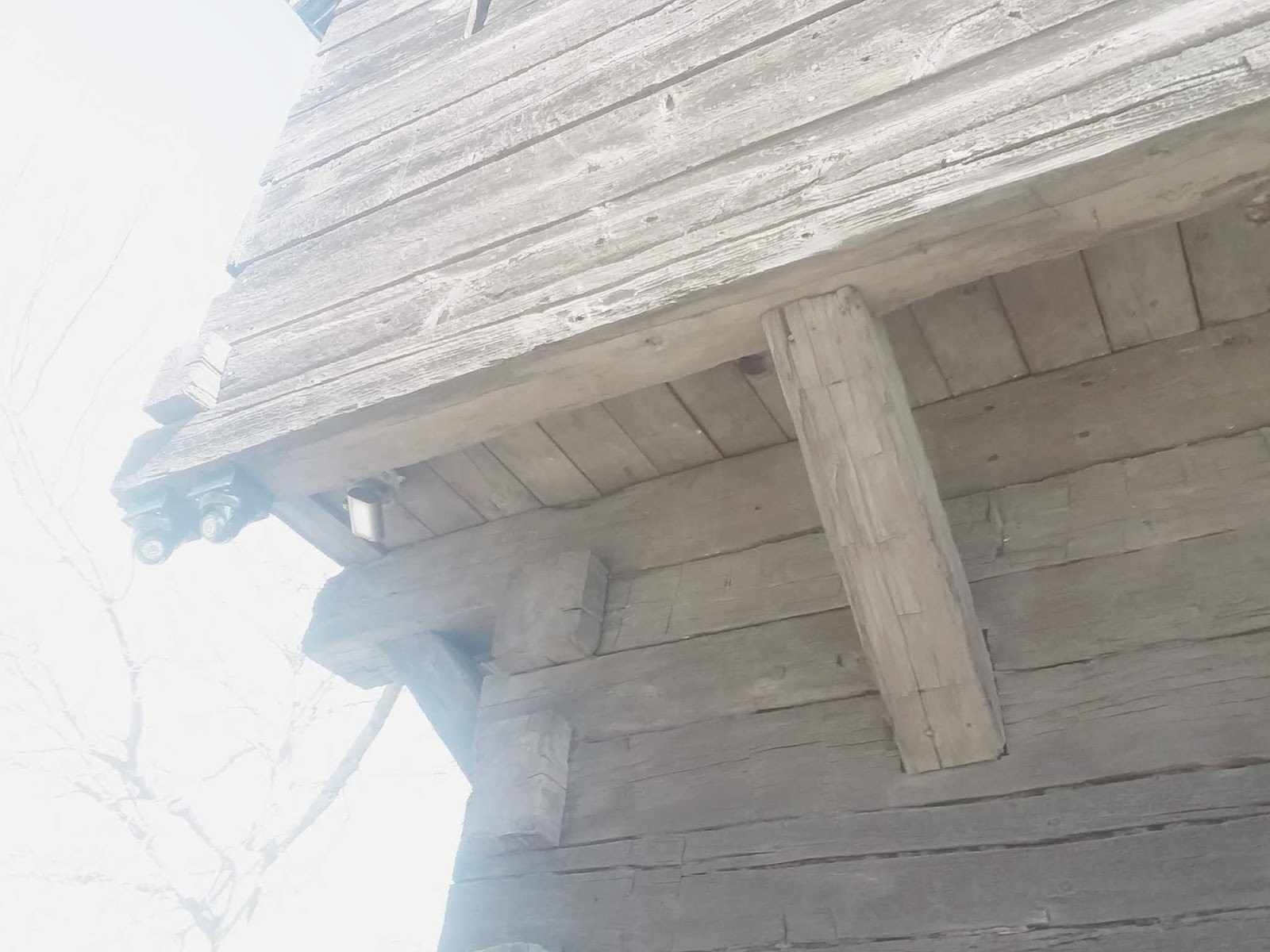
The Stillwater Blockhouse


In the small Saratoga County town of Stillwater, on the banks of the Hudson, lies a park with an 18th Century style blockhouse. While not an original construction from the era, it has an interesting history of its own. 


In 1927 the blockhouse was constructed to celebrate the 150th Anniversary of the Battle of Saratoga, what many consider the turning point of the American revolutionary war. It was then placed on the battlefield, a National Historic Park, and used as the original visitor center for the park.  At some point, the park stopped using it as a visitor center but kept it on the park where it fascinated visitors and let them see what a small fortification of that era would have looked like, 


The problem with the blockhouse though was that no such fortification ever stood at the battlesite and its presence confused visitors some of whom thought it had been used in the battle. In 1999, a decision was made to remove the blockhouse and put it in this small scenic site on the banks of the Hudson where visitors can picnic and enjoy the site. 

What follows next are a series of pictures of the blockhouse. I've attempted to include photos showing details for people who might wish to know how it was constructed or have enough information to build a model of it. 

After that I've included pictures of the park, and after that a few pictures, just for fun, of the non-authentic model cannon that someone built and put in the lot of the apartment building next store. 


The park itself is located at a scenic site on the banks of the upper Hudson so I've includede several photos of that.


Finally, the apartment building next door has a model cannon behind its parking lot, overlooking the Hudson. It's clearly something that was built for fun, constructed out of what seems to be PVC pipe, and completely and totally non-firing and contains many inaccuracies. It should not be viewed as an authentic replica of a weapon of the time. (an homage perhaps? ) Regardless, it was kind of fun and there's no reason not include these photos of it. Perhaps someone will have fun counting the inaccuracies in the model.


A few people wrote their name in the concrete while it was wet.  


Miniature Wargaming --15mm Boxer Rebellion Russians

The Boxer Rebellion was a conflict that occured in 1900 in China. It began when a secret society called "Yi He Chuan" or "Yi He Tuan" emerged. The names mean "Fists of Harmonious Righteousness" and "Society of Harmonious Righteousness" respectively. It was a reactionary group that tried to use magic and Chinese mystical traditions to drive foreign influence from their nation. This included violence against missionaries and their local converts, as well as attacks on the embassies in Beijing. (It is worth mentioning that the Chinese had never really seen much purpose for embassies from foreign countries and had only permitted their appearance as one of the terms for peace following a series of conflicts with the British and other foreign nations.

A Russian force for the conflict in 15mm scale. Most of the figures are from Old Glory 15s but there is a unit of the old Frontier Miniatures infantry in front. Some liberties were taken with uniforms in that most, if I understand correctly, are wearing their winter pants with their summer shirts. This is how they are shown in the Osprey book to the period, but I've seen photos from the conflict that show them dressed entirely in their summer uniforms. In classic wargaming style, I chose color over accuracy. 


The Chinese refer to the conflict as "the Eight Nation War," because it involved warfare between their nation and eight other nations all of whom were involved in colonialist endeavors in China. In fact, however, the bulk of the foreign troops came from four of the nations. These were Britain (who sent mostly Indian troops ), the USA, Japan, and Russia. The other four nations who fought, France, Germany, Italy, and Austria-Hungary sent much smaller forces, token forces,or forces that arrived after the conflict began.

Russian artillery and a pair of commanders. A force like this really should include some automatic weapons but this one doesn't. Neither range included gatling or machine guns. 


When the conflict began, Russia took advantage of the need to protect foreign interests and civilians by sending a large force into Manchuria, intent on conquest and acquisition of territory.
According to most sources, the Russian forces were very brutal and prone to mistreating and committing atrocities on the Chinese civilian population. However, according to some sources, strangely enough, the Russians, being a force of largely, unsophisticated peasants, did not have some of the condescending attitudes that other Europeans had when in China. In other words, while they did burn down houses, loot indiscriminately, and rape and brutalize people, it wasn't because they felt they were better than those people. Merely because they had the chance to do so. Yeah, not much of a consolation I know. But history is often full of strange, tragic situations.


Russian Infantry. Old Glory 15s. 


Two units of Cossacks


A unit of Russian dragoons. 

If you wish to support this blog, you can purchase these books from Amazon through these links. They are not intended to be a definitive bibliography on the subject. Cohen's a history in three keys is a classic on the conflict but sparse on military details. It does make it clear that in addition to fighting in the main conflict the Russians were fighting their own campaign in the north east. Bayonets before Bullets is considered by many to be the best book available on the Russian army of the period and how it fought and campaigned. However, it is out of print, expensive to acquire, and I read it by borrowing from the library through interlibrary loan and would recommend you consider doing so. The Osprey book on the subject is not a bad introduction although it is considered to have some innacuracies in it.


If interested, these are three of my books written by me. Please feel free to purchase them and support this blog that way as well.


Trump and Musk -What is motivating them? What is their end goal? Partial thoughts First

Trump and Musk -What is motivating them? What is their end goal? Partial thoughts First . . . what the heck is going on here? What are Donal...