Spartacus TV Show Fight Scenes --How realistic were they? Part Two

Greetings! Welcome back. I'm starting to get a bit of the hang of blogging, and hope to do more consistent and regular posting over the next few months. In return, it would be nice if you, the reader, could consider following the blog, leaving comments, sharing posts, or even going so far as to purchase the items I have linked to in the posts. In other words, do what you can please to make me feel like my efforts here are being noticed and rewarded so that I find myself eagerly continuing. Over the next few months, I hope to put up posts about the Dead Rabbits / Gangs of New York miniature gaming project ( https://history-for-fun-profit-and-insight.blogspot.com/search/label/Gangs%20of%20New%20York )  , the Chop Sockey! Kung Fu Miniature Wargame Rules project ( https://history-for-fun-profit-and-insight.blogspot.com/search/label/Kung%20Fu%20gaming ), posts about historical sites I saw on my recent trip to Asia (https://history-for-fun-profit-and-insight.blogspot.com/search/label/Asia )
 , book reviews, and several posts about upstate New York Revolutionary War / American War of Independence historical sites I have visited ( https://history-for-fun-profit-and-insight.blogspot.com/search/label/American%20War%20of%20Independence ) as well as other historical and gaming projects. Please support this blog by following it, encouraging others to check it out, and letting me know you are following it too. I've got a lot of stuff I'd like to write about and share, but I could really use some encouragement and a sense that people are enjoying and appreciating what I am doing here. So please help out.  Thanks.

And this week, I go back to a subject that has interested me since the beginning of this blog. Roman Gladiators ( see https://history-for-fun-profit-and-insight.blogspot.com/search/label/Gladiators for other articles on the subject.) I do some Roman Gladiator wargaming and have a writing project on the subject partially done and moving ahead slowly. It started as a brief wargamers guide to the subject, got too long, and may ultimately become a wargamers guide and a set of rules for the period. (For those who wonder, until I write my own, allegedly perfect set of rules, I am using a set called "Hoc Habet Hoc" which can be purchased here: https://www.wargamevault.com/product/297688/Habet-Hoc-Habet-Rules-for-Gladiatorial-Combat as a download or here http://scalecreep.com/product_info.php?products_id=2951 as a physical book, which is how I bought it. By the way, I don't get kickbacks or commissions from these links so if you do follow them to make a purchase please tell them I sent you and I am a nice guy who enjoys their products. I bought mine from Scale Creep and had no problems with the order.)

Which, FINALLY perhaps, brings me to the subject at hand. Months ago I wrote an article on the historical accuracy of the fight scenes in the TV show Spartacus. I promised a sequel, and FINALLY am getting around to writing it. If you haven't read it yet, it'd probably be a good idea to bring yourself up to speed by checking out the first half of this here: https://history-for-fun-profit-and-insight.blogspot.com/2019/05/starz-tv-spartacus-series-were-fight.html

As stated, Spartacus, from Stars TV, was a delightfully lurid show full of blood and nudity, unremitting violence, sexuality, and huge servings of adult content of all kinds, set in the days of old Rome that focused on the lives of gladiators, a gladiator ludi (school), and an uprising against oppression. While not for everyone, if you could stomach it, it was very entertaining and includes such things as the most emotionally satisfying decapitation scene I've ever been exposed to on the big or small screen.

For those who are lacking, here's an exposure to one of the fights from the show (while the clip comes from a French dubbed episode, the series was originally filmed in English)


Here's another, this one set in the training hall of the ludus, where the slaves are trained to become gladiators. Hence the wooden swords and lack of armor:


Again, it's probably not a bad idea to read the first half of this before proceeding, not 100% necessary, but recommended: https://history-for-fun-profit-and-insight.blogspot.com/2019/05/starz-tv-spartacus-series-were-fight.html

Previously I noted that aside from the ahistorical helmets with exposed faces (allowing the viewer to get a better sense of the emotions and drama taking place in the story), the actual arms, armor, and styles of gladiators are often surprisingly accurate historically speaking.

What is not historically accurate, however, is the intensity and lethality of the fighting.

Perhaps, surprisingly, most historical gladiator fights in the arena were not to the death. While, generally speaking, the historical gladiators were slaves and could be used as their owner saw fit, they were quite valuable, well trained, highly skilled, and difficult to replace slaves who if utilized properly could make their owner a great deal of money. It would make no sense, economically, for the owner of such a slave to risk his investment unnecessarily or recklessly.

Therefore, gladiator battles to the death were few and far between and seen as very special events.

According to Stephen Wisdom in the Osprey book on the subject, pages 58-59, and many authors on the subject, the actual rates of death were something as follows. Of 100 1st Century duels, only 19 of the 200 gladiators who participated in the fights died. That's about 9 to 1 odds of a gladiator surviving his bout. This changed over time and according to the same source, by the third century, the odds of a gladiator dying in a bout were about 1 in 4. Now, 1 in 4 odds of dying is quite high, but it is still far less than that show in the show Spartacus. (and for those wondering the show is set around the events of 73B.C, when the famed revolt took place.)

Roland Auguet spends time describing the career path and life path of gladiators in his book, Cruelty and Civilization, The Roman Games (1972, 1994, Routledge and Barnes and Noble publishers) on pages 178-183). He describes one 30 year old gladiator who had fought in the arena 34 times. Of these he had won 21 times, the fight was declared a draw or "stans missus" 9 times, and he had lost 4 times but had his life spared. He also concludes that most gladiators only fought about twice a year during the peak of their professional career and says they should be thought of as entertainers less than fighting machines.

Thomas Wiedemann on page 119-124 in Emperors and Gladiators gives detailed information on the numbers of fights some gladiators participated in. It's interesting and informative. but such a sampling does not give a complete picture, although it most certainly provides a sense that some gladiators lived a surprisingly long life with many fights.

Nossov's Gladiators -Rome's Bloody Spectacle is probably the single best book I've found on the subject and since it is published by Osprey, it focuses on exactly the sort of detail that wargamers wish. In this work, on pages 150-151, Nossov offers interesting information on mortality rates among gladiators. He also cites the work of George Ville but says that by the 2nd and 3rd century fights to the death were increasingly the norm. Of course, this is centuries after Spartacus. He also points out that more successful gladiators were more popular gladiators and the more popular a gladiator was, the more likely the mob and the editor of the games were to spare him if he lost. Nossov considers this a factor when mentioning that some champions fought "60, 80, 88, 107, 125, and even 150" fights.

FYI,  many of these authors cite Ville, George. La gladiature en Occident des origines a la mort de Domitien ( Ecole française de Rome (1981) ). I have not read this work. It is over 500 pages and in French, a language I've never studied and have only a limited, passing knowledge of. 

If the subject of mortality among gladiators is of interest to you, Nossov includes this in his footnotes: Kanz and Grossschmidt,  Head Injuries of Roman Gladiators, Forensic Science International, Vol. 160, No 2 (2006) pp 207-16. It's another work that I have not read, at least not at the time of this writing but may hunt down and read some day.

In the academic work, Rules of engagement, by M.J. Carter, published in The Classical Journal, Vol. 102, No. 2 (Dec-Jan 2006/2007) pp 97-114, the author writes of funeral epitaphs of Roman gladiators. He offers the possibility that gladiators, who were highly trained highly valuable slaves, may have been trained in techniques to defeat an opponent WITHOUT killing or seriously wounding their opponent. He also offers an unexpected series of examples of funeral epitaphs where gladiators proudly stated in their funeral epitaphs how few people they had killed and how many lives they had saved. He argues that the professionalism of a gladiator often included not killing his peers unless forced to and that if a gladiator broke this "code," he would find himself a target for other gladiators who not only might wish to avenge the death of a friend at his hand, but also remove an unnecessary danger in their workplace. In other words, gladiators who tried to unnecessarily kill other gladiators were not much liked by professional gladiators who were already working in a dangerous job.

Therefore, as entertaining as the show Spartacus is, it is safe to say that its lurid depictions of gruesome, gory fights to the death with blood splashing all over the arena sands and the TV screen, are sensationalized and not historically accurate.


Recommended books on Types of Gladiator and their 
Arms, Armor, and Fighting Styles


These three books all have good details on the types of gladiators and how they fought. My personal favorite is Nossov's Gladiator, Rome's Bloody Spectacle and I can't recommend it highly enough if the subject interests you. The Gladiators and Caesars book is also quite good, but be forewarned only one chapter of this book focuses specifically on gladiators. The others tend to discuss things like chariot racing or animal fighting or other arena and coliseum type events.


Mentioned in this blog post.


This is an unusual yet well done book that contains interesting but largely hypothetical descriptions on how to train and fight in a realistic manner that may be similar to how the Roman gladiators fought. It's currently being sold by two different publishers so it's available on Amazon from two different sources. After Paladin went bankrupt, the rights reverted to the author and it was soon re-released.


Finally, a pair of books on the history of the Spartacus revolt. I've read both of these (I've read everything I've linked to on this page. In some cases, you can even find my reviews on Amazon for the products.) and I definitely prefer Strauss's The Spartacus War over the Osprey book. I have however included the link to the Osprey book as many people (myself included) just like Osprey books and they don't take up much space on the shelf. 


Finally, if you wish to support this blog, please consider buying any of the following books, all written by yours truly. People who've read them, tell me they've enjoyed them. 


Gangs of New York #2--Painting the "Dead Rabbits Gang," and did they even exist?

An 1857 newspaper illustration of the Dead Rabbit Riot 


In a previous post, (  https://history-for-fun-profit-and-insight.blogspot.com/2020/02/gangs-of-new-york-gaming-figure-and.html ), I wrote of figure availability for Gangs of New York gaming.  But, after one has figures representing the Dead Rabbits Gang, the next obvious question is how does one paint a member of the Dead Rabbits Gang? How, exactly, did these mid-nineteenth century slum brawlers dress? Did they have a distinctive look? And here's where problems come in.

Let's start with a look at the sources. According to The Great Riots of New York, page 92, the author writes of the Dead Rabbits, "their uniform was a blue stripe on their pantaloons,"  Alas, that seems to be it for this source. The entire description. All there is. However the author notes that one of their rival gangs, the Roche Guards, wore a red stripe in contrast.

If we turn to Ashbury's classic, The Gangs of New York, we get the following: on page 23, we learn that the Dead Rabbits had a red stripe on their pants, while the Roche Guards were the ones with the blue strip on their pants. The exact opposite, and, yes, I double checked that, in fact, I double and triple checked that a few times and they definitely contradict each other. Ashbury also describes the Dead Rabbits as "at the head of their sluggers carried a dead rabbit impaled on a pike." Ashbury, by the way, does not footnote or give sources. (And I think in this context, a "slugger" is a violent person who fights, not a club or baseball bat.)

And, if you don't believe me, and wish to double or triple check for yourself, both of these books are available online through sources such as archive.org and project gutenberg among others so you may check for yourself. (My personal guess is that Ashbury went to the Great Riots book and mis-copied in his notes, but that's just a guess.)


The Victorian Armchair General's depiction of the Dead Rabbits Gang. Alas, no painting guide although the wonderful people at TVAG seem to offer everything else. http://www.thevirtualarmchairgeneral.com/200-bhoys.html
Scorse's film, Gangs of New York, offers an alternative image.

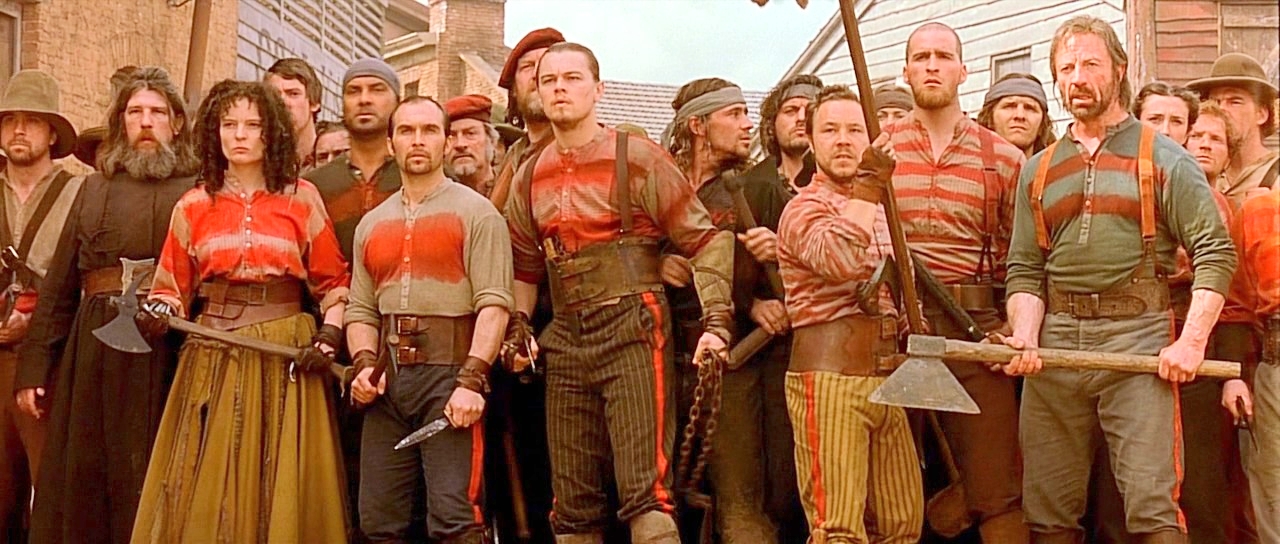
If we go to Scorsese's movie, the Dead Rabbits are shown with the orange striped shirts (something that is nowhere in the book, and, at least sometimes, red striped pants.

The Dead Rabbits as show in the film. Aside from the red (or is it orange?) stripe on the pants and the dead rabbit on a pole, the rest seems to be invented. I have not been able to find a source for those stripes on the shirts, for instance.

Searching further, I also found a source selling a pair of Dead Rabbit pants that were apparently used as props in the film.


So, that's the film depiction of the Dead Rabbits Gang of the mid-nineteenth century. But should we take the film seriously as a source of details on how the gang dressed? Sadly, absolutely not.

If one goes to JSTOR, an academic database for scholarly articles, and does a search on "Dead Rabbits Gang" and related terms, one finds surprisingly little on the gang, perhaps for reasons that will become clear later. If you do searches to find what historians think of the film, you will soon learn that they universally note that the film was not intended as an accurate depiction of history, and include quotes from people involved in the decision making for the film where the filmmakers make it clear that accurate historical representation was not among the goals of the film.  (I've save several of these articles. If readers wish request, and perhaps even if they don't, I will try to share these sources later.) In the meantime, this interesting article, supports the contention that the film was not intended as accurate history.

See: https://www.thewelcomeblog.com/stories-of-new-york/gangs-of-new-york-facts-vs-fiction/4/2/2016 for one source. It's an interesting, well illustrated read, with nice pictures of the buildings and neighborhood, that gives a good introduction to both the period and the controversies about not just the extent of Gangs of New York type gangs and gang violence, but hints at the issue of whether or not the even existed at all.

In Tyler Anbinder's historical work, Five Points, he makes the case that the Dead Rabbits Gang did not exist at all and was instead a creation of public fears exaggerated by the media of the time. Anbinder argues his case well  and if you wish, you may go to his book and read his arguments on pages 284-289. He argues that the predominant gang of that time and place was the Roche Guards and the term "the Dead Rabbits" came from an incident where one faction of the group entered a meeting held by another faction and threw a dead rabbit on the table.

Which, by the way, muddles the whole "Roche Guard/ Dead Rabbit" / "Blue stripe / red strip" controversy completely, or perhaps just settles it for good, if we conclude that they were one and the same group. Perhaps.

Needless to say, if the group did not exist, it does pose a quandary for people like myself who wish to paint them in miniature in a historically accurate fashion. Alas!! It's not easy sometimes being a historical wargamer. Not only do people laugh at our strange modelling passions, but we have problems like this, problems that the general public just cannot begin to fathom or grasp. Alas! Tragic indeed.

To understand the issues involved, the issues underlying how a belief could be spread about a savage Irish gang that historians argue did not exist, one needs to understand just how strong and pervasive anti-Irish sentiment of the time was. The period cartoon below depicts the Dead Rabbits Riot of 1857 and illustrates this nicely. Personally, I think the Irish rioters shown look absolutely "Orcish," bearing a closer resemblance to fantasy gaming figures of goblinoids than actual humans.

Irish Rioters of the 1857 Dead Rabbits Riot in New York City as depicted in an editorial cartoon of the time. Personally, I think they look like Tolkein or Dungeons and Dragons Orcs. 

Crime Groups, Gangs, Reality, and Urban Legend in History and Popular Belief

It seems that there is a possibility that the Dead Rabbits were more of a legend than a reality. In future installments, I hope to discuss the implications for gaming. 

At the moment, however, it seems worth mentioning that this may not be unique. There are other cases where reality and fantasy have overlapped in the minds of many people. 

In mid-nineteenth century India the British colonial officials became quite concerned about a group known as "the thuggee" or "strangler sect." According to popular belief of the time, members would travel around India, finding unsuspecting victims and then strangling them as a sacrifice to the god Kali. While I make no claim to be able to judge the controversy, some modern historians have argued that the sect never existed, at least not to the extent believed by the British officials, and the British attempts to outlaw and suppress the sect stemmed from fear and hysteria. (See: https://en.wikipedia.org/wiki/Thuggee for an introduction to this controversy, and, yes, I just cited wikipedia and did so on March 1, 2020 if one wishes to know which version. Some day, particularly if I live forever, I hope to explore this controversy in depth.) 

Ninjas. Did Ninjas exist? The answer is definitional and depends on how one defines the term "ninja." Of course, in late medieval Japan, there were assassins and spies. But did the legendary "ninja clans," the families with hidden identities where children were raised and trained from birth to be super-human, black-clad, clandestine killing machines dressed in , exist? Probably not. And as for the black "ninja suit," it appears that the black suit tha is commonly associated with the ninja, actually came form the traditional outfit worn by Japanese stage hands several centuries later. These stage hands were required to sneak on stage and move the set around without being spotted by the audience. So in that sense, it appears that ninja did not exist. (At least for the moment, you'll have to trust me on this. It's something I may write about in the future. For the moment, this info comes from several threads on the old H-Asia discussion group as well as elsewhere. Someday I hope to spend time and really look into this issue in a thorough fasion. At least two good looking books on this very question have come out recently. I have read neither. I also have several "how to be a ninja" martial arts books in my collection and it would be nice to blog about them some day.)  It is worth mentioning that the belief in superhuman ninja assassins raised from birth, seems to have been cncouraged by the people who employed spies and assassins, the feudal lords of the time, who wished their enemies to be fearful of their capabilities. 

In our own society, not too long ago (1980s and 1990s), there was or has been a controversy about the prevalence and acts of Satanic cults. While many believe these were or are active in the USA, commiting horrific crimes, the FBI actually went so far as to issue a report stating they were not.( see: https://www.ncjrs.gov/pdffiles1/Digitization/136592NCJRS.pdf ) I did some writing about this in the end of this long post and books on the issue are available at the end of the post: 
https://peterhuston.blogspot.com/2019/06/experts-more-questions-about-tammy-yard.html

It is not unknown for people to believe in violent criminal groups that do not exist.

Just FYI, years ago, I wrote a book on Chinese criminal groups in North America. While the book is so outdated that  I rarely recommend it, and there are things I would do different in writing such a book today, I have included a link to it below should anyone be interested. I did learn things about the subject of crime groups while writing it.


Books and Media for the period. 

There is a variety of media one can get if you wish to explore this period of American history in more depth. Please remember, if you order through these links you are supporting this website.

First, once again, we have this wonderful set of rules. 


Second, we have Herbert Asbury's classic yet sensationalized work, "Gangs of New York." Asbury was writing in the 1920s about life in the mid-nineteenth century and historians who look it over pretty much universally feel he was more interested in entertaining the reader than sticking to the facts and presenting a historically accurate document. It's an entertaining read that has been through several editions, but should not be taken as gospel. This is probably why when you look for more details and other sources on some of the things he describes you simply don't find them, as it is likely that they never existed.

Tyler Anbinder's "Five Points: The 19th Century New York City Neighborhood that Invented Tap Dance, Stole Elections, and Became the World's Most Notorious Slum," is a more serious history of the time and place written by a contemporary author. The two books at times contradict each other. 


The Great Riots of New York is a late nineteenth century work that describes historical events as the author understood them to have happened. It is probably one of the sources Asbury used to write his book and parts of it are well worth reading to understand this period.


Yes, there was a big Hollywood movie based on these things and the events in Asbury's book. Perhaps unexpectedly, I was not a particularly big fan of the film, neither are the people at TVAG either by the way, they make that clear in the introduction to their wonderful rules, and it is also not particularly accurate in its depiction of history. Dates are mixed and some of the details not quite right. Nevertheless, if you are going to game this period, it's gotta be a "must-see" film so,  if you wish, consider buying it through this link.


I was a bigger fan of a much lesser known BBC-America show called "Copper," which portrayed the adventures of a New York City police detective during the American Civil War. The show ran for two short seasons only and the actual number of episodes is a bit limited but it was a very interesting series and gives an interesting depiction of the underside of the City of New York at the time, even if it does not mention any of Asbury's gangs. Be forewarned that is a very dark and at times difficult to watch series but very well done. For instance, several episodes of the first season deal with the main character's attempts to get a 12 year old prostitute off of the streets and into a better life. She is portrayed disturbingly realistically. The situation is complicated when it turns out she is fleeing an abusive, yet completely legal, marriage to a man three or four times her age, and the legal options under the laws of the time are quite limited when he announces he wants her back. (The age of marriage at that time was much, much lower than now.) Worth watching if the period interests you and you can stomach dark materials.


Please be aware-

while there are only two seasons of the show available, they are being sold in several different packages so there are six items listed below.


And one more time, the awesome rules . . . 


Finally, my books . . . 

Yeah, I've written books. Please check them out and see if they interest you.


My book on criminal groups written in 1995

Chop Sockey! Kung Fu Wargame Miniature Rules playtest


Chop Sockey -Kung Fu Miniature Wargame Rules is one of my current works in progress. The goal was to create a set of rules that would be simple and fun to play while allowing for the flexibility needed to recreate the battle action of a classic kung fu movie or comic book. While much work remains to be done, we had our first real test play, and the basic concepts seem to work surprisingly well. 

Troops and characters are divided into four classes: minions, fighters, warriors, and heroes. 

Minions are those mobs of virtually useless combatants who get mown down by the dozen when the hero enters the room. 

Fighters and warriors are more ordinary people with the warriors being a step up from the fighters. Picture your elite samurai or commando-types and you have the basic idea. 

Heroes, well, heroes are heroes, except of course the heores who are really villains, and regardless highly skilled in kung fu and other deadly arts. They dominate the game, but that's the way it should be.

Close combat is handled by rolling large quantities of dice and comparing the difference in the die rolls. Aside from no hit at all, the results can be a hit, a deadly hit, or a spectacular hit. A spectacular hit is so frightening that it causes enemies to check morale. 


A long view of the set up for the game. At one of the table, you can see a jungle stockade where bandits have been holding women and children as prisoners. They are being held by an arch villain (a hero in game terms) and two five man units of bandits with sub-machine guns (fighters) and two five man bands of traitorous peasants (minions) who have allied themselves with the  bandits and their villainous yet highly skilled leader.
On the other side, are three bands of peasant militia (fighters), one with rifles and two with spears. They are led by three heroes and two native guides (specialists rated as warriors). Their goal is to cross the river, storm the stockade and rescue the prisoners.  

Another view of the set up. 


The evil bandits and their prisoners.


The good guys, come to rescue the prisoners.


The prisoners.


 A close up of the mountain bandits. These are Westwind's Montagniards (delightfully inaccurate Montagniards by the way) from their Vietnam range.


The game ended in a clear victory by the good guys who destroyed the villains and easily won the game. While some rules and stats need to be tweaked, 

Gangs of New York gaming -- figure and rules availability

In the nineteenth century, at least according to some reports, the streets and neighborhoods of the great city of New York were dominated by large, violent gangs with exotic names. The Dead Rabbits, the Pug Uglies, the Roche Guards, and the Bowery Boys were only some of names of gangs associated with the period. Would the battles between these gangs and /or sometimes the authorities make good wargames? There's no reason they wouldn't.

There are many manufacturers of suitable figures and even a couple lines of miniaturess intended specifically to represent the old gangs of mid-nineteenth century New York, not to mention a set of rules for the period that look quite nice as well as scenery. .

The following is an overview of some of the more prominent lines. If you know of others, please share in the comments. All photos of the figures come from the manufacturers website, and, honestly, are used without permission and no attempt at copyright infringment. My hopes are that they will appreciate the free reviews and publicity. When my figures are painted, I hope to share photos.

TVAG or The Victorian Armchair General

TVAG or "The Victorian Armchair General" offers many interesting products including both figures specifically for the period, downloadable PDFs for scenery, and an interesting set of rules for the period. I ordered from them once, and was quite pleased with the experience and intend to order from them again. While I have yet to actually play the rules, I do own them and they are a fun read and look like they will produce a fun game. They have been around for years and even revised a couple times.

You may find their website here: http://www.thevirtualarmchairgeneral.com/230-bhoystowne.html


The above figures represent Asbury's depiction of "The Dead Rabbits," a savage Irish slum gang who entered battle with a dead rabbit on a pole as their standard.


These represent "The Shirt Tail Gang," more brawlers from the Five Points slums who entered battle with their shirts untucked so no one would mistake who they were. (Yeah, Asbury's stuff is great fun.)

The people at TVAG -The Victorian Armchair General, even have figures for the police in uniforms from both the 1840s and the 1850s-1860s.

[As an aside, shortly before the Civil War, as tensions grew between the two political parties in New York State, there were two police departments that patrolled the city fighting crime and each other. Yes, it was a strange time. One police force was created by the city government and the other by the state government. They considered each other illegitimate and occasionally battled each other and even released each other's prisoners.]


The Victorian Armchair General (TVAG) also makes downloadable PDF scenery for the period, as well as "B'hoys," a fun looking set of rules for riots, brawls, and other urban engagements of the period.


BRIGADE GAMES


Brigade games makes beautiful figures for a wide variety of periods, including figures that appear to be specifically designed to recreate the events and characters of the film, "Gangs of New York." While I am, perhaps unexpectedly, actually not a fan of the film, they are beautiful figures. Currently they are not labelled as "Gangs of New York" figures and tucked in, almost hidden away with the Victorian Age figures on their website, but the resemblance to characters in the film is obvious. They cost a bit more than the TVAG figures (a dollar more per figure at the time of writing) but are well worth getting. I ordered all five packs and am pleased with what I have. On the other hand, I do need to say that I have ordered from Brigade Games three times and twice the order was just slightly off with a figure missing, or an unordered figure, or a mislabeled package of figures in the order and it was a nuisance getting what I had paid for and finding out what the results would be. As I write, I am waiting on them to fix an order that was ordered over two months ago and they say should have arrived, due to backordered stock, two weeks ago.

You may check out their website here: http://brigadegames.3dcartstores.com/Victorian-Age_c_221.html


PERRY BROTHERS


Tucked away in their US Civil War line, Perry Brothers has four packs of rioters to represent participants in the New York City draft riot of that conflict. While I have not seen the figures themselves, I do have several packs of Perry Brothers figures for World War Two (alas, still unpainted) and the American War of Independence (which I have in many cases painted). Their figures are beautiful and while I ordered them through an independent game and figure dealer (now closed), next time I intend to order from them directly. I expect if there were problems with their customer service, I would have heard about it but have not. 

There is, of course, no one reason one could not use figures intended for the 1863 draft riots as participants in the New York City Dead Rabbits Riot of 1857, six years earlier, or other troublesome people roaming the streets of New York waving sticks and throwing bricks. 


CASTING ROOM FIGURES

Casting Room Figures is a British company connected with Wargames Foundry. While I am not sure what the exact relationship is, I ordered these and other figures off of The Casting Room Figures website and they arrived in the USA quickly and without incident. I believe they can also be ordered off of the Wargames Foundry website. These figures were part of their Victorian line, a few decades later than the period we're aiming for but still serviceable figures.

You can find the Casting Room miniatures website here: https://castingroomminiatures.com/ and this range in particular here: collections/victorians-edwardians


West Wind Miniatures EMPIRE OF THE DEAD line

This is really a "steampunk" fantasy line with many fanciful, interesting, or in some cases, just plain weird figures in it. However, they do make some useful figures for the period we're talking about particularly urban looking horse drawn wagons. I ordered these figures through Brigade Games, who no longer plan to stock the line, and if I wish more in the future intend to order straight from the manufacturer.  You may find their website here: https://westwindproductions.co.uk/index.php?route=product/category&path=65


Of course, they make figures aside from the wagons, which I just had to have. I received, by mistake, this figure of someone called "Cedric Hyde," described on the website as Mr Hyde of Jekyl and Hyde's illegitimate son. I'm not sure what I'll use him for, but he'll either get that silly looking gun chopped off and be used for this period or thrown in with the science fiction figures.


Now this, of course, I just had to have. Alas, while ordered and charged for, I get Cedric Hyde instead. Discussing the shipping was a nuisance.


Like many "steampunk" ranges, the range does contain useful figures if one is looking for mid-nineteenth century thugs and gang members. While I did not order these figures, they do look quite suitable for what I am doing and perhaps I should have.


Other Manufacturers

Of course, there are many other places suitable figures can be found. Wild West, Colonial, and Steampunk ranges all offer possibilities, but one can also explore ranges for the American Civil War, the Alamo and Texas War of Independence, and other ranges as well. If you find any good ones, please feel free to mention them in the comments section. 


Books and Media for the period. 

There is a variety of media one can get if you wish to explore this period of American history in more depth. Please remember, if you order through these links you are supporting this website.

First, once again, we have this wonderful set of rules. 


Second, we have Herbert Asbury's classic yet sensationalized work, "Gangs of New York." Asbury was writing in the 1920s about life in the mid-nineteenth century and historians who look it over pretty much universally feel he was more interested in entertaining the reader than sticking to the facts and presenting a historically accurate document. It's an entertaining read that has been through several editions, but should not be taken as gospel. This is probably why when you look for more details and other sources on some of the things he describes you simply don't find them, as it is likely that they never existed.

Tyler Anbinder's "Five Points: The 19th Century New York City Neighborhood that Invented Tap Dance, Stole Elections, and Became the World's Most Notorious Slum," is a more serious history of the time and place written by a contemporary author. The two books at times contradict each other. 


The Great Riots of New York is a late nineteenth century work that describes historical events as the author understood them to have happened. It is probably one of the sources Asbury used to write his book and parts of it are well worth reading to understand this period.


Yes, there was a big Hollywood movie based on these things and the events in Asbury's book. Perhaps unexpectedly, I was not a particularly big fan of the film, neither are the people at TVAG either by the way, they make that clear in the introduction to their wonderful rules, and it is also not particularly accurate in its depiction of history. Dates are mixed and some of the details not quite right. Nevertheless, if you are going to game this period, it's gotta be a "must-see" film so,  if you wish, consider buying it through this link.


I was a bigger fan of a much lesser known BBC-America show called "Copper," which portrayed the adventures of a New York City police detective during the American Civil War. The show ran for two short seasons only and the actual number of episodes is a bit limited but it was a very interesting series and gives an interesting depiction of the underside of the City of New York at the time, even if it does not mention any of Asbury's gangs. Be forewarned that is a very dark and at times difficult to watch series but very well done. For instance, several episodes of the first season deal with the main character's attempts to get a 12 year old prostitute off of the streets and into a better life. She is portrayed disturbingly realistically. The situation is complicated when it turns out she is fleeing an abusive, yet completely legal, marriage to a man three or four times her age, and the legal options under the laws of the time are quite limited when he announces he wants her back. (The age of marriage at that time was much, much lower than now.) Worth watching if the period interests you and you can stomach dark materials.


Please be aware-

while there are only two seasons of the show available, they are being sold in several different packages so there are six items listed below.


And one more time, the awesome rules . . . 


Finally, my books . . . 

Yeah, I've written books. Please check them out and see if they interest you.


Ping Pong as a Survival Skill -a Story from the Chinese Cultural Revolution

When we think of survival skills, many don't think outside the box or limit the range of such skills. Recently, I spoke with a Chinese friend who is from Wuhan, epicenter of the coronavirus. While he teaches at a college far from Wuhan, his parents still live there. As the entire city has been quarantined with no one going in or out, there is good cause to worry.

He said they are doing well but running low on food. He said he has been ordering food off the internet to deliver to them but it takes a long time to get there and he is worried. I asked if there was anything I could do. Of course, there's not really, and reminded him that his parents had survived worse and that his mother had once survived based on her ping pong playing skills.

Apparently, during the Cultural Revolution, a period of total chaos and dysfunction in Chinese history due to insane political extremism, at some point she'd found herself homeless and adrift in territories far from home. (I'm not sure how this happened, but it was not uncommon at this time. The authorities would occasionally order urban people, particularly intellectuals, to move to the countryside to "learn from the peasants" and since the peasants (farmers) often didn't particularly want them there, and society was falling apart, people would find themselves far from home without resources or food or means of making a living. It didn't help that young people were joining the Red Guards, roaming around unsupervised and trying to force the implementation of poorly thought out government mandates. They'd sometimes quite and try to find a way home too.

So this young woman, all by herself, far from home, found herself in need of food and shelter. Often one step in doing this was to find the local ping pong table where she happened to be and use it to make friends with strangers. Which often led to offers of a meal and food for the night.

(As an aside, due to China's high population density, people tend to often live in small, crowded houses or apartments. In a city like Wuhan, this would have made it difficult to stockpile a long term food supply, although a lot of the Karen (Burmese hilltribe) refugees I know in the USA have a few 50 pound bags of rice around somewhere in their houses or apartments. It's not a bad idea dn it makes them happy.)

Trump and Musk -What is motivating them? What is their end goal? Partial thoughts First

Trump and Musk -What is motivating them? What is their end goal? Partial thoughts First . . . what the heck is going on here? What are Donal...