Miniature Wargaming --15mm Boxer Rebellion Russians

The Boxer Rebellion was a conflict that occured in 1900 in China. It began when a secret society called "Yi He Chuan" or "Yi He Tuan" emerged. The names mean "Fists of Harmonious Righteousness" and "Society of Harmonious Righteousness" respectively. It was a reactionary group that tried to use magic and Chinese mystical traditions to drive foreign influence from their nation. This included violence against missionaries and their local converts, as well as attacks on the embassies in Beijing. (It is worth mentioning that the Chinese had never really seen much purpose for embassies from foreign countries and had only permitted their appearance as one of the terms for peace following a series of conflicts with the British and other foreign nations.

A Russian force for the conflict in 15mm scale. Most of the figures are from Old Glory 15s but there is a unit of the old Frontier Miniatures infantry in front. Some liberties were taken with uniforms in that most, if I understand correctly, are wearing their winter pants with their summer shirts. This is how they are shown in the Osprey book to the period, but I've seen photos from the conflict that show them dressed entirely in their summer uniforms. In classic wargaming style, I chose color over accuracy. 


The Chinese refer to the conflict as "the Eight Nation War," because it involved warfare between their nation and eight other nations all of whom were involved in colonialist endeavors in China. In fact, however, the bulk of the foreign troops came from four of the nations. These were Britain (who sent mostly Indian troops ), the USA, Japan, and Russia. The other four nations who fought, France, Germany, Italy, and Austria-Hungary sent much smaller forces, token forces,or forces that arrived after the conflict began.

Russian artillery and a pair of commanders. A force like this really should include some automatic weapons but this one doesn't. Neither range included gatling or machine guns. 


When the conflict began, Russia took advantage of the need to protect foreign interests and civilians by sending a large force into Manchuria, intent on conquest and acquisition of territory.
According to most sources, the Russian forces were very brutal and prone to mistreating and committing atrocities on the Chinese civilian population. However, according to some sources, strangely enough, the Russians, being a force of largely, unsophisticated peasants, did not have some of the condescending attitudes that other Europeans had when in China. In other words, while they did burn down houses, loot indiscriminately, and rape and brutalize people, it wasn't because they felt they were better than those people. Merely because they had the chance to do so. Yeah, not much of a consolation I know. But history is often full of strange, tragic situations.


Russian Infantry. Old Glory 15s. 


Two units of Cossacks


A unit of Russian dragoons. 

If you wish to support this blog, you can purchase these books from Amazon through these links. They are not intended to be a definitive bibliography on the subject. Cohen's a history in three keys is a classic on the conflict but sparse on military details. It does make it clear that in addition to fighting in the main conflict the Russians were fighting their own campaign in the north east. Bayonets before Bullets is considered by many to be the best book available on the Russian army of the period and how it fought and campaigned. However, it is out of print, expensive to acquire, and I read it by borrowing from the library through interlibrary loan and would recommend you consider doing so. The Osprey book on the subject is not a bad introduction although it is considered to have some innacuracies in it.


If interested, these are three of my books written by me. Please feel free to purchase them and support this blog that way as well.


Social Media Hoax: Alexandria Ocasio Cortez

[UPDATE FROM MARCH 9,2020]


Arguably not history, but it's been a while since I posted here, and when I created this blog, I had hoped to do more here to expose the problem of pseudo-history, pseudo-archeology, and other false claims about history. (And while I'm on the subject, please check out the work of Jason Colavito . He's got a great blog, a free e-mail newsletter, he sends out each week like clockwork and lots of good stuff. Honestly, one reason why I skipped several proposed posts on false historical claims was that Jason Colavito has already done them.) This was originally posted on my other blog, peterhuston.blogspot.com , a less focused blog where I post about many subjects on an intermittent schedule. You can see it here, if you wish: https://peterhuston.blogspot.com/2019/02/social-media-hoaxes-alexandria-ocasio.html

So . . . with no further ado, a post on what will some day be a minor historical hoax. (Hmmmm. When do current events become history?  Heavy thought.)

I like to think the truth has a value. I like to think that misrepresentation is grounds for suspicion and looking carefully at the motivations of the people making them. And having said that, I think it's obvious that a lot of people out there are very, very scared of Alexandria Ocasio-Cortez, also known to many as "AOC." At least scared enough to knowingly spread lies about her. In these pages, I hope to expose some of those lies and misrepresentations.

For the record, I am actually not a fan of Alexandria Ocasio-Cortez and her views. Honestly, in most cases, I don't claim to know enough about many of the issues she talks about and the economics surrounding them to hold an educated view. I do think she's making following the news more fun, and that it's great to see the field of discussion expanded when it comes to suggesting solutions to societal problems. (For instance, while I do not feel qualified to discuss whether a 70% tax on the extremely rich is a good idea or not, I think it's great that the idea has been not just proposed but also put in historical context as something that has been done in the past.)

I support truthful discussion and even attacks on her proposals and political views. This is what American politics should involved. I do not consider dishonest attacks on her character to be good, helpful, or conducive to a healthy political climate in our nation.

So, with that said, let's look at a hoaxed AOC photo, I found on FB.

First, here's the photo:

[UPDATE --OBVIOUSLY THE PICTURE IS GONE. WHY DO THEY DISAPPEAR LIKE THAT? IF SOMEONE KNOWS PLEASE EXPLAIN IN THE COMMENTS SECTION. WHILE I AM VERY PROUD THAT I DID MY OWN "DETECTIVE WORK" AND FOUND THE ORIGINAL PHOTOS MYSELF, THEY ARE NOW GONE FROM THIS BLOGPOST. WHY? WHY? WHY?
REGARDLESS, SOMEONE ELSE DID IT TOO, AND HERE'S THEIR WEBSITE:
https://www.truthorfiction.com/alexandria-ocasio-cortez-splits-image/  THANKS GUYS.]


While not my original work, this gives the basic idea of what I discovered. 


Image may contain: 3 people, people smiling


Obviously, not very flattering. Also, perhaps equally troubling, it offers no political insight or commentary and contains zero discussion of any issues. Which makes it even more problematic.

But looking into it a bit more, I found this.


Image may contain: 4 people, people smiling


Clearly one of these photos is an alteration of the other. Same young man holding a woman with spread legs, same room, even the same news show in the background. Obviously one is a photoshopped alternation of the other. And I think it's safe to say the upper photo is the reworked one. There are several reasons for this. The clothes on the upper photo do not look real to me. 

Not sure what to make of that "flaming fart" spewing forth from her bottom, but then again, that's not really the point of the thing, is it?

I also think that on the one above, AOC's head looks reattached. My guess is that the head shot used came from here:  

Image result for alexandria ocasio-cortez laughing


So . . . cheap smear job. Nothing more. Bad photo job. Again, if you want to attack OAC, and do it in a fair and fact focused, mature manner that contributes to mature political discussion, be my guest. I encourage it. But cheap smear jobs are nothing but cheap smear jobs and only weaken our nation and lower the level of political discourse.

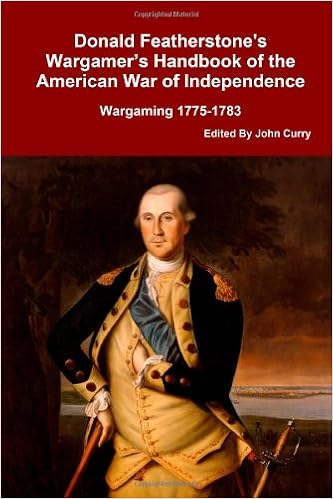
Book Review Donald Featherstone's Wargamers Handbook of the American War of Independence


Recently I purchased this book from Amazon. Quick review after giving it an evenings examination, partial reading, lots of skimming, is that while it's not awful it's not really that great either. I would not recommend it, except to the completist. The work is basically a reworking of a book he wrote in 1977, although with editing and new portions added by a gentleman named John Curry (hence the 2010 copyright date on this.)


Donald Featherstone was one of the classic publicizers and promoters of the hobby. In 1977, the year after the American bicentennial when interest in the period was high, he released the early edition of this book. Therefore the bulk of the information in this book is "state of the art" but for the 1970s. Much has changed since then, and not just with the death of disco.

Hardcover Wargamers Handbook of the American War of Independence 1775-1783 Book

Today's wargaming guides usually contain much more detailed information on uniforms, unit sizes, and troop types than this book contains. The author's ideas on what a set of rules should or should not contain are a key part of the book and some of these, for instance, the use of "chance cards" are less popular now than they were then.

A picture from an AWI Wargame I recently played using a friends figures and terrain.
Rules used were first edition Black Powder from Warlord Games and the conflict was hypothetical.

In some portions I caught what I feel are errors.

For instance on page 28, he refers to "Rogers' Rangers" as the most famous of the "ranger units" of the war. I would question this. It is my understanding that while Robert Rogers, head and founder of the famed French and Indian War Roger's Rangers, did found a second rangers unit during the revolution, he soon left it to do other things having been forced from military service due to "poor health" (he suffered from alcoholism at this time) and it became much better known as "the Queens Rangers" under the command of  John Graves Simcoe.

Another photo of the same game as described in the above photo.
On page 31, he states that the Brunswick and Hesse-Hanau line regiments had not just a grenader company, but also a light company. This seems to be false. I have looked into the issue and they did not. Of course, in fairness to Featherstone, I am writing 40 years later and have the benefit of access to 40 more years of research on the matter, much of it done by decades of obsessive wargamers trying to answer this very question. While on one hand, it seems to be unfair to attack this book, judging it by modern standards, on the other hand, it is being sold on Amazon with a 2010 copyright date.

The battle guides are also not up to modern standards. For instance, most modern day gamers when reading of a battle wish to know exactly which units were there and how large each unit was. Instead the gives the number of troops on each side and hints at this with large sweeping numbers. While this information is generally available elsewhere it is the sort of thing expected in a modern wargamers guide to a conflict.

Another photo of the same game. British troops assault the American line.

Some parts, however, have been updated. For instance, there is an update, useful list of figure manufacturers included at the end. The modern day editor, John Curry, also added a set of wargame rules for the period, written by Featherstone as well. So it is an updated text. On the other hand, in my opinion, the primary value of this book for a modern wargamers who games the American War of Independence is as a historical document, a look at the earlier days of the hobby. If takes as such, it should be a fun read and purchase, a stroll down memory lane. But if one expects an up-to-date guide to the period of modern standards, you are likely to be disappointed.

If one wishes to buy this book and support this blog, please feel free to do so by using the link below. 


If interested, these are three of my books written by me. Please feel free to purchase them and support this blog that way as well.


Pulp Fiction Asian Bandits


People seem to like seeing pictures of nicely painted figures so here's a recent project. If anyone asks these are "modern day Pulp-fiction Asian fantasy Bandits" and should not be seen as representations of any historical or modern day people. The figures are actually 28mm Montagniards from Westwind Productions Vietnam War range and while nice figures, they don't resemble any photos of Montagniards from the period that I've ever seen. As for the Buddha in the tree trunk scenery piece that came from the aquarium decorations section of the pet area of a particularly large Walmart. Again, I refuse to comment on whether or not it's actually representative of anything anywhere.


Close ups of some of the figures. What's with the guy in the gasmask? No idea.
If someone has ever heard of SE Asian people donning gasmasks please let me know. 


Again, no idea if it's historically accurate but it'd make a great pulp fiction character. 


Updates on the blog

Greetings!! 


It's been about six months since I've started the blog.

It seems time for a round-up, a few thoughts and lessons learned, and announcements on coming changes. The original plan for this blog was to provide new content regularly in the areas of history, wargaming, historical and non-historical miniature gaming, media reviews, and media reviews.

I'm surprised that more people have not used the tags and scrolled through the older posts. There's some good stuff there. If you like history, use the tags. If you like photos of miniature figures, use the tags.

You may wish to know, I have books on several subjects for sale
 -- Books by Peter Huston at Amazon.

Current projects that I am working on include:

1. Bloody Sands, Cheering Stands --Miniature Wargame Rules and Wargamers Guide to the Roman Gladiators and Arena

2. 18th Century North American Wargaming Miniature Rules (working title is "Flintlocks and Funny Hats" but I hope to find a better one)

3. Chop Sockey!! Kung Fu Miniature Wargaming Rules

The above three will influence the content of this blog.

4.  Holidays at the Ambulance, 1986 --a novel that has been completed but remains in search of a publisher.


Recently released projects include 


Put Your Favorite Picture Here: Awesome Tales of Space Aliens, Vampires, Pop-Stars, Human Beings, And Other Truly Strange, Amazing, Amusing, And Disturbing Things as Written by the Award Winning, World Travelling, Life Saving Author Peter Huston


Since its founding, some of the pieces have gotten hundreds of hits.

For those interested, the top five posts were:


Two of these I'd classify as well-researched pieces (the Smallpox in China and the Uighur Unrest pieces ). The Mary Dyer piece, I'd classify as light but little known history, something else I'd hoped to provide here. The pieces on the Roman arena were both gaming pieces and I suspect they attracted interest because they had nice pictures of interesting models and were shared in popular internet forums.

In the next few months, I hope to include more content. This will include straight pieces on historical subjects, wargaming photo pieces, and media reviews (especially book and film reviews.). These last pieces, the media focused pieces, will include links so that interested people can purchase the items and thus bring provide money and encouragement for the blog. Movie reviews are something I have no included in the past.

A Sampling of Other Blog Posts


In the meantime, should you wish to check out the past blog posts, there were several others that I either consider well done or wish had gotten more attention. You can check them out here. :

1. Iroquois housing and architectural shift at the time of the American Revolution (plus some gaming stuff)

        This one contains some well done research on an interesting question on a little known topic --Iroquois adaption of western housing styles. It also contains information on the subject for miniature wargamers.

2. Ancient Rome - What was the arena and what were “the games”?

3. Confucianism, Communism, and their Intersection in North Korean Symbolology.

4. Did the Chinese discover America? Is Gavin Menzies a genius? Hell, no. Smallpox shows they did not.

5. Did Marilyn Monroe get a rib removed to appear more slender?

        This one, interestingly, is getting a lot of hits at one of my other blogs, but not here.

6,  "Ambulance Dogs" in the German Army, circa 1900

7. Pseudohistory, Creationism, and Dinosaursl

8. South East Asian Cultural Boundaries of the Pre-Modern World and their Continuing Effects on the Modern World

9.  Historical European Martial Arts (H.E.M.A.), the Rondel or medieval dagger, and the Fiore Dei Libri manuscript

10. General Tso's Chicken and Jennifer 8. Lee's Chinese food presentations


Finally, for those interested, here is the least viewed post.


          Fourteen people read this one. I don't know why. I think it's very interesting. It even has links to music videos. How can anyone be unhappy with piece that includes music videos? And personally I think more people should learn the story of Tommy Page. Check it out. Be number 15. Learn who Tommy Page was and why I consider him worth mentioning.


Indians in the American Revolution and Depictions of Iroquois from Fort Stanwix and Oriskany

The American Revolution ( American War of Independence) produced many changes in North America. One of these was the end of the Iroquois Confederacy as an important political entity. 


An exhibit from the Fort Stanwix visitor center showing two Iroquois and a trader from the period.

============
The war in the Mohawk River Valley, then a frontier region of New York, was a civil war. The Whites fought each other, loyalists against those favoring independence, and among the Iroquois Six Nation Confederacy, the nations split, some favoring the American cause, others preferring their traditional loyalties with the British, particularly as the British had promised to help them curb the spread of the aggressive, land-hungry American settlers, and others struggling to remain as neutral as possible in what they considered a White man's war. 


Many Iroquois, particularly the Mohawks, left their home region soon after the war. 

Many of these events focused on a fortification called Fort Stanwix. It is now a National Historical Park and located in Rome, New York, a small city located between Syracuse and Utica. ( see: the National Park Service Website for Fort Stanwix. ) 

The Oriskany Battlefield, perhaps the most important battle of this part of the war, is located a little bit to the East. 

I have a strong interest in the history of the American Revolution (War of Independence) and wargame the period. Among my current projects are a large number of half-painted 25mm Old Glory "woodland Indians with rifles" that I intend to use as Iroquois. I'll try to include some photos of them when they are finished, but here's what the looked like a couple weeks ago. Clearly, there's a great deal of detail and color left to be added. 


Therefore, for those with similiar interests, I offer the following photos from the Fort Stanwix visitors center. Apologies for the poor quality of some of the photos. I have come to the realization that if I wish this blog to be its best, I must improve my photography skills and hope to spend some time on that soon. 

Let's begin with some close ups of the above exhibit. After we will follow up with period and later depictions of some of the key Iroquois involved. 

The life size Iroquois models from the exhibit.
======

Notice the bead work on the straps and the knife.
=====
Detail on the bag.
=======


This and the one below show the headdress detail on the models.


awful picture but does show some more detail from another angle
=====

Same poor quality but the other Iroquois model in the display.
======


 Important Iroquois of the Time depicted in the Museum


This is a fuzzy photo (apologies) of the Seneca leader Cornplanter ( Gy-ant-wa-chia )
You can find a better image of this painting, plus a full biography at either of these two pages Cornplanter on Wikipedia or Indigenous People Net 


OH MY!! An even worse photo of the exhibit on Red Jacket. Although he reportedly fled the battle of Oriskany early in the fighting he went on to become an important Iroquois statesman. See these sites for better depictions and more details: wikipedia or Indigenous People Net

Iroquois housing and architectural shift at the time of the American Revolution (plus some gaming stuff)

If you have looked at this blog much, you will know that I enjoy miniature wargaming, model building, and studying history, among other things. Currently I am looking into local history from the American Revolutionary War era and reading "The Iroquois in the American Revolution," a classic work by Barbara Graymont (1972, Syracuse University Press.) Please note the link to purchase this book and support the blog below.

Which got me to thinking, what sort of houses did the Iroquois live in at this time and what sort of fortifications did they have?

Traditionally, the Iroquois lived in multi-family longhouses in walled villages. Many illustrations of them exist.  I've included several below, but before you look at them, let's think a bit. Did the Iroquois live in the longhouses at the time of the American Revolution?


For the record, Iroquois still live today and today they do not live in longhouses. Even at the most traditional Mohawk and/ or Iroquois settlements today, you are not going to find people living in longhouses. (In fact, my father once helped with a construction project at Ganienkeh, a radical, Mohawk / Iroquois separatist community with both a Mohawk language school and a stubborn insistence that they are part of the sovereign Mohawk nation, not subject to US or Canadian law. He helped build some houses. They were, for the record, of modern design and not longhouses.)

So when did the architectural shift take place? Like so much in Iroquois history and society, the shift, it seems took place in the mid-eighteenth century.But first let's look a bit at the traditional housing and styles of community lay out.


According to Graymont, pages 9-10, while some of the longhouses were single family, most were multi-family, The number of longhouses in a community varied widely, depending, as one would expect on the size of the community. "Small hamlets" might have just four to five longhouses, while the largest Iroquois communities could have over one hundred longhouses, as well as walls and structures for smoking food and other necessities of community life. The smallest longhouses were  "20 feet long, 16 feet wide, and 15 feet high" (about 6m. by 5m. by 5m) according to Graymont, while the average was "60 feet long, 18 feet wide, and 18 feet high" (about 18m. by 5.5m by 5.5m) again according to Graymont. The largest on record, she says, was 334 feet long by 23 feet wide. (about 102m. long by 7m wide). She gives no height but as longhouses were curved in shape, I think it's safe to estimate it was between 18 and 23 feet high ( 5.5m to 7m. approximately).  She also gives detailed descriptions of the construction and other architectural details of these longhouses. As these are easily found through a websearch, I see no need to share them here. 


Again according to Graymont, these traditional settlements were often fortified. As this is a detail of much interest to wargamers, it seems worth quoting the entire paragraph from the book in full:

"The Iroquois lived in stockaded villages located usually in easily defensible high places near a supply of water. The log palisades were from fifteen to twenty feet in height, in single, double, triple, or quadruple lines, interlaced, and then reinforced with heavy bark. A deep ditch might surround the palisades with the dirt being thrown up to form an embankment next to the palisade. A bark battlement might also run along the top and, in time of war, be supplied with piles of stone to hurl down upon the enemy and jars of water to extinguish fires started by burning arrows. After 1600, when the power of the Iroquois Confederacy was at its height, and particularly after 1700, with the end of the Iroquois wars, fewer of the inner villages of the Five Nations were heavily palisaded. A more modest type enclosure was all that was needed to keep the forest animals from scavenging in the village," (Graymont, pp. 9-10)


However, we are talking about the time of the American Revolution (or as they say in the UK, "the American War of Independence" ), a period when Iroquois culture and politics was in great flux, a time when, as one science fiction series says in the prologue, "everything changed."

So did the Iroquois live in such houses at this time? It seems some did but an increasing numbers of others were adopting White housing styles.  Again, it seems worthwhile to include Graymont's entire paragraph on this:

"Toward the end of the eighteenth century, the Iroquois began to build the same type of log houses used by the white frontier settlers. An occasional well-to-do Indian would even build a frame house in imitation of his more affluent white neighbors. Bark houses survived to some extent well into the middle of the nineteenth century but gradually gave way to the sturdier dwellings copied from the whites." (Graymont, p. 10)


This house is a modern reconstruction of a house on the Saratoga Battlefield, a National Historic Park. It is shared merely to show a typical house of the time and place discussed. You may see other photos at https://benedictarnold.smugmug.com/Battles-of-Saratoga/John-Neilson-House/ I did not wish to infringe upon the copyright of those photos but there is one there that includes people and clearly shows the small size of the house, not uncommon in those days.

===
Graymont also includes an interesting story about an Oneida church built in the 1770s. While the missionary who promoted the  church in the first place, Samuel Kirkland, followed a school of theology known as "the New Light Principle" which held that churches need not have steeples and Baptism with water was not essential for salvation (Note: I hope to research this more. It sounds like the teachings of the Religious Society of Friends / "Quakers" may have had an influence here.) his local parishners, Oneida felt otherwise and in 1774 when the church was two years old decided, over his objections that it was unnecessary, that their church should have a steeple insisting, in Graymont's words, that "if white people could have steeples over their churches, so could they. Indian religion was worth no less than the white man's religion." (Graymont, p. 46)

While it was not this church, you may see photos of another Iroquois built church (Mohawk-built) from this era here: https://indiancastle.church/


As for Iroquois fortifications of the era, they are mentioned in several places in this work and in the histories of that time. Lacking knowledge to the contrary (at least at this time of writing), I would assume they would have been a mix of the fortifications described above along with the White style of frontier fortifications of the time.


Stillwater, New York Blockhouse Museum ( https://www.albany.org/listing/stillwater-blockhouse-museum/1006/ )


The Old Stone Fort from Schoharie New York ( see https://theoldstonefort.org/our-museums/old-stone-fort/  )

WARGAMING 


I am painting a large quantity of northeastern woodland Indians from that era, a large bag of 25mm Old Glory French and Indian War figures that were donated to me by a friend who never got around to paint them. ( Product ID: FIW-01 Natives Advancing with muskets ) Although in my mind they are supposedly Iroquois, I do not guarantee the details are correct, some of the hairstyles in particular look quite "iffy" but they are good enough for wargaming particularly as I did get them for free.


They will supplement the old RAFM Flint and Feather figures that I bought and painted years, really decades, ago. ( RAFM Flint and Feather ) I'll try to post pictures later. I also hope to do some supplements with figures from other ranges as well. Perry Brothers and Warlord Games both have some nice looking figures for the period but I am sure they are not alone. Bob Murch and Crucible Crush have an exciting looking line called "Flint and Feather" of pre-European and time of European contact Iroquois and Algonquins that while not quite right for this period seems nevertheless definitely worth mentioning.


ADDITIONAL LINKS

A New York State Museum exhibit and presentation on Iroquois longhouses. 
http://exhibitions.nysm.nysed.gov/iroquoisvillage/

Another website with lovely pictures of longhouses and Iroquois architecture.
https://www.hhhistory.com/2016/04/the-iroquois-longhouse.html


Should you wish to purchase one, this company makes resin models of Iroquois longhouses for wargaming. Although I've linked to a particularly nice looking one, there are others on their site, as well as a blockhouse and stockade walls, under the "American Frontier" section. Please note I have not done business with this company or seen their products in person.
https://achesoncreations.com/index.php?option=com_virtuemart&view=productdetails&virtuemart_product_id=82&virtuemart_category_id=16

A fun website that gives instructions on how to build your own model longhouses for wargaming if you do not wish or are not able to spend money on resin cast models.
https://onelover-ray.blogspot.com/2011/04/how-to-build-no1-fiw-indian-longhouses.html


I stumbled across this while researching this blog, a biography of Samuel Kirkland, the missionary to the Iroquois mentioned above. I have not read it yet but it seemed worth noting and sharing. 
https://archive.org/details/samuelkirklandsm00lenn 


Trump and Musk -What is motivating them? What is their end goal? Partial thoughts First

Trump and Musk -What is motivating them? What is their end goal? Partial thoughts First . . . what the heck is going on here? What are Donal...